A-Z Construction & Restoration

The most expensive mistake Syracuse homeowners make with chimneys is not ignoring damage. It is misreading it.
A homeowner sees spalling brick and pays for a tuckpointing job that addresses the symptom but not the cause. Two winters later, the same mason is back, and the repair scope has doubled. Or the opposite happens: a contractor calls for a full rebuild on a chimney that needed $800 worth of crown work and a liner chimney inspection. Both errors cost money that didn’t need to be spent.
After 40 years of chimney assessment work across Onondaga County, the most useful thing we can offer a homeowner is not just a list of problems. It is a clear framework for reading those problems correctly. What you’re looking at on the exterior of your chimney tells a specific story about what’s happening inside, and knowing how to read that story is the difference between a repair that lasts and one that doesn’t.
This guide covers nine chimney conditions we diagnose regularly across the Syracuse metro area, what each one actually indicates structurally, and the specific thresholds that determine whether repair or rebuild is the correct response. If your masonry shows any of these signs of failure, the first step is to schedule a free structural chimney inspection to determine if a simple repair or a full rebuild is necessary. We will give you a written assessment and fixed-price estimate before any commitment is made.
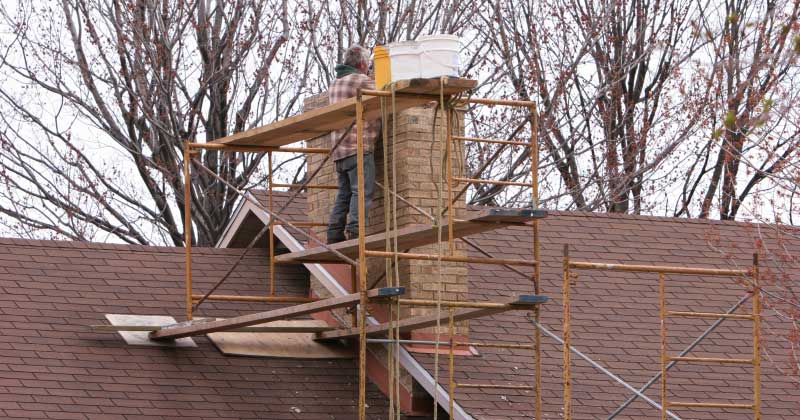
How to Use This Guide
Each section below covers a specific chimney condition. For each one, we describe what you’re seeing, what it means structurally, and a clear repair-vs-rebuild threshold based on our field experience in Central New York. Some conditions are straightforward repair territory. Others are almost always rebuild territory. A few depend entirely on how far the damage has progressed, which is why a professional assessment matters before any scope decision is made.
One important note: chimney conditions rarely appear in isolation. Spalling brick and failing mortar joints usually share a root cause (moisture). A leaning chimney and a cracked flue liner are often related to the same foundation movement. When you are reading through these nine conditions, look for clusters. Two or three issues appearing together almost always indicates a systemic problem that repair alone will not solve.
1. Cracked or Spalling Brick
Brick cracking and spalling, the flaking or fracturing of the brick face, is the most visible chimney problem and also one of the most frequently misdiagnosed. Not all cracked brick means the same thing, and the repair scope varies enormously depending on what the cracking pattern tells you.
- Surface spalling (shallow flaking of the brick face, typically less than 1/2 inch deep) is almost always a moisture and freeze-thaw issue. The brick surface has absorbed water, that water has frozen and expanded, and the outer layer has fractured away. If the structural core of the brick is intact and the damage is limited to individual bricks scattered across the chimney face, selective brick replacement combined with waterproofing treatment is appropriate.
- Deep spalling (fracturing that has penetrated more than one-third of the brick depth) is a different problem. At that depth, the brick is losing structural capacity, not just cosmetic integrity. When deep spalling is present across more than roughly 25% of the chimney face, the masonry can no longer perform its load-bearing function reliably. This is rebuild territory.
- Stair-step cracking, the diagonal cracks that follow the mortar joints in a staircase pattern, indicates differential settlement. The chimney is moving, and the mortar joints are the path of least resistance. Stair-step cracking across multiple courses is a structural warning sign that repair alone will not address.
- Vertical cracks running through bricks (not along mortar joints) indicate tensile stress. The chimney is being pulled apart by movement or load. This is serious and typically requires engineering assessment before any scope decision.
- Repair threshold: Surface spalling on fewer than 25% of bricks, with structural cores intact.
- Rebuild threshold: Deep spalling across large sections, stair-step cracking across multiple courses, or vertical through-brick cracks.
2. Leaning or Separating Chimney
A chimney that is visibly out of plumb, leaning away from the house, or showing a gap between the chimney mass and the exterior wall, has a foundation or footing problem. This is not a masonry surface issue. No amount of tuckpointing or brick replacement will correct structural movement at the base.
In Onondaga County, chimney lean typically has one of three causes: footing failure due to inadequate original depth (pre-1940 chimneys frequently have footings that do not extend below the frost line), soil movement due to drainage problems or frost heave, or water infiltration that has deteriorated the mortar bed courses at the base of the chimney over decades.
The threshold question with a leaning chimney is not repair vs. rebuild. It is almost always rebuild. The real question is from where: a partial rebuild from the roofline is sometimes appropriate if the lean is minor and the footing is sound, but if the footing itself has failed, the chimney must come down to grade and the footing must be replaced before reconstruction begins.
Any visible lean should be assessed by a professional before further use of the fireplace. A chimney that is moving has compromised flue liner joints, which means combustion gases are no longer reliably contained.
- Repair threshold: None. A leaning chimney requires structural intervention, not surface repair.
- Rebuild threshold: Any visible lean or separation. Scope (partial vs. full) depends on footing condition.
3. Deteriorating Mortar Joints
Mortar joint failure is the single most common chimney repair we perform across the Syracuse area, and it is one of the conditions most sensitive to how it is addressed. Done correctly, tuckpointing is one of the highest-value repairs a homeowner can make. Done incorrectly, with the wrong mortar hardness, inadequate depth, or poor joint finishing, it accelerates the damage it was meant to stop.
The standard of care for tuckpointing requires removing failed mortar to a minimum depth of 3/4 inch before new mortar is packed. Anything shallower is a cosmetic repair that will fail within a season or two. Mortar hardness must be matched to the existing masonry. Using modern Type S mortar on a pre-1960 chimney built with soft lime mortar causes the brick itself to crack, because the rigid new mortar transfers thermal stress into the brick rather than absorbing it.
The repair-vs-rebuild decision on mortar joint failure comes down to extent and structural consequence. Isolated joint erosion on a chimney that is otherwise plumb and structurally sound is repair territory. Widespread mortar failure across all four faces of the chimney, particularly where bricks have already begun to shift or loosen, typically means the chimney has lost enough cohesion that tuckpointing alone cannot restore structural integrity.
What to look for:
- Mortar recessed more than 1/4 inch below the brick face
- Mortar that powders or crumbles when probed with a key
- Bricks with visible movement or looseness
- Gaps at the top of joints where debris has accumulated
Repair threshold: Mortar failure on fewer than 50% of joint faces, with bricks stable and chimney plumb.
Rebuild threshold: Widespread failure across all faces, loose or shifted bricks, or mortar failure combined with structural movement.
4. Water Damage and Active Leaking
Water damage is a symptom, not a cause. When a homeowner tells us their chimney is leaking, the first task is always to identify the entry point because the source of the water determines the correct repair, and misdiagnosing it is extremely common.
The four primary water entry points on a chimney are the crown (top cap), the flashing (junction with the roof), the brick and mortar faces (direct infiltration through porous or failed masonry), and the flue cap or chase cover. Each has a distinct repair. Replacing the crown when the flashing is the source, or waterproofing the brick face when the crown is cracked, will not stop the leak.
We determine the entry point through systematic inspection: examining the crown for cracks and proper slope, checking flashing for gaps and proper embedding into the mortar joints, looking for efflorescence patterns on the brick face (which indicate the direction of water travel), and inspecting the flue cap seating. In ambiguous cases, controlled water testing from the roof identifies the source definitively.
What to look for:
- Water in the firebox after rain or snowmelt
- Efflorescence (white chalky deposits) on exterior brick
- Ceiling or wall staining adjacent to the chimney
- Rust on the damper or firebox floor
- Musty odor from the firebox during or after rain
Repair threshold: Active leaking with an identifiable, isolated entry point (crown, flashing, or cap).
Rebuild threshold: Water infiltration through failed masonry across large sections, or long-term unaddressed leaking that has caused structural saturation and brick deterioration.
5. Flue Liner Damage
The flue liner is the most safety-critical component of the chimney, and also the one homeowners are least likely to be aware of until something goes wrong. Its job is to contain combustion gases, including carbon monoxide, and protect the surrounding masonry from the heat of those gases. When it fails, both functions are compromised.
Most chimneys in Onondaga County built before 1985 have clay tile liners. Clay tile is durable under normal conditions but susceptible to thermal shock and to cracking caused by chimney settlement over time. A single hard chimney fire where creosote ignites inside the flue can crack an entire clay tile liner in one event, often without any visible exterior indication.
Flue liner damage is not visible without inspection. The standard for liner assessment is a Level 2 inspection using a camera system that allows the full interior surface to be examined. We recommend a Level 2 inspection for any chimney that has had a known flue fire, shows signs of draft problems or smoke backdrafting, or is being evaluated for a change in heating appliance.
For cracked or deteriorated clay tile liners, stainless steel liner installation is the standard repair — a continuous steel tube, properly sized and insulated, that eliminates the crack-and-separate failure mode of clay tile entirely. This is the repair specified by NFPA 211, the national chimney safety standard.
What to look for:
- Smoke or combustion odors in the home when the fireplace is not in use
- Poor or inconsistent draft performance
- Clay tile fragments visible in the firebox
- History of a chimney fire or extremely hot burn
Repair threshold: Minor liner cracks without structural chimney compromise – stainless steel liner installation.
Rebuild threshold: Liner failure combined with structural masonry damage, or liner collapse that has affected the surrounding chimney structure.
6. Chimney Crown Failure
The chimney crown, the concrete cap that covers the top of the chimney surrounding the flue opening, is the chimney’s primary defense against direct water entry. It is also, in our experience, the most commonly neglected element of chimney maintenance across the Syracuse area.
Many crowns on older Onondaga County chimneys were built too thin, without adequate overhang, or with mortar rather than concrete, none of which is appropriate for a surface exposed to full Syracuse winter weather. These crowns crack within years of construction and begin admitting water that travels down through the chimney core, causing damage that appears much lower in the structure and is frequently attributed to the wrong source.
Crown assessment from the ground is limited. Binoculars may reveal obvious cracking, but a meaningful crown inspection requires roof access. If your chimney has not been inspected in more than five years and was built before 1990, assume the crown needs attention until a professional has confirmed otherwise.
- Repair threshold: Surface cracking without structural failure. Professional elastomeric crown coat seals existing cracks and provides a flexible waterproof membrane.
- Rebuild threshold: Multiple large cracks, missing or broken sections, or crowns built without proper thickness or overhang. Remove and rebuild with properly formed concrete.
7. Flashing Failure
Chimney flashing is the metal sealing system at the junction of the chimney and the roof. It is one of the most common sources of chimney leaks in the Syracuse area and one of the most frequently misdiagnosed because the water entry point (the flashing) and the visible damage (ceiling staining, interior wall damage) are often in different locations, and the path water takes between them is not obvious.
Correct chimney flashing is a two-part system: base flashing that is bent up against the chimney face and integrated with the roofing material, and counter-flashing that is embedded into the chimney mortar joints and laps over the base flashing. When either component fails, when the counter-flashing pulls out of the mortar joint, the base flashing lifts at the low side, or the sealant at the counter-flashing edge cracks, water runs freely behind the flashing and into the roof structure.
Flashing repair ranges from resealing the counter-flashing edge (a minor repair if the metal is in good condition) to complete tear-out and reinstallation. We coordinate with roofing contractors when full flashing replacement requires integration with the roofing system.
- Repair threshold: Sealant failure with sound flashing metal — reseal and re-embed counter-flashing.
- Rebuild threshold: Corroded, lifted, or improperly installed flashing, full tear-out and reinstallation.
8. Firebox Deterioration
The firebox, the interior chamber where combustion occurs, is lined with refractory brick and refractory mortar, both of which are engineered to withstand direct flame and extreme heat cycling. Standard brick and standard mortar are not suitable for firebox repair, a distinction that matters because incorrect repairs using the wrong materials fail quickly and can create fire hazards.
Firebox deterioration in older Syracuse-area homes typically presents as cracked refractory brick, eroded refractory mortar joints, or rust and spalling on the firebox back wall. Minor joint erosion is repaired with refractory mortar. Cracked refractory brick requires replacement with matching material. Rust on the firebox back wall sometimes indicates that the problem is actually a flue issue driving condensation back into the firebox rather than a firebox material failure.
A firebox that has been repaired with standard mortar or standard brick, a common DIY mistake, needs to be assessed carefully, because the non-refractory materials may have already allowed heat transfer into the chimney structure beyond the firebox.
- Repair threshold: Isolated refractory mortar erosion or individual cracked refractory bricks: repair with appropriate refractory materials.
- Rebuild threshold: Widespread refractory failure, structural cracks in the firebox surround, or evidence that heat has transferred into the chimney structure beyond the firebox.
9. Age-Related Cumulative Deterioration
This is the condition that doesn’t fit neatly into any single category and it’s the one that most often leads to the right rebuild decision being made too late.
A chimney built in 1955 in Syracuse has absorbed approximately 70 winters of freeze-thaw cycling, 70 heating seasons of thermal stress, and 70 years of moisture exposure. Its clay tile liner is near or past its expected service life. Its original lime mortar has been eroding for decades. Its crown, if it’s the original, was built to standards that predate modern chimney construction codes by 40 years.
When a chimney of this age presents with two or three of the conditions above simultaneously, the repair-vs-rebuild calculation changes. Each individual problem might be repairable in isolation. But repairing the crown on a chimney whose liner is failing and whose mortar is at end of life means you will be back on that roof within two or three years addressing the next item. At some point – and experienced masons develop a feel for exactly where that point is – the cumulative cost and disruption of serial repairs exceeds the cost of a well-executed rebuild that restarts the clock on all components at once.
The honest assessment we give homeowners in this situation: if you are looking at three or more of the conditions in this guide appearing on the same chimney, get a written scope for both a comprehensive repair and a rebuild, compare the 10-year cost projection of each, and make the decision with complete information. We provide both options at our free inspections when the situation calls for it.
- Repair threshold: One or two isolated conditions on a chimney that is otherwise structurally sound.
- Rebuild threshold: Three or more conditions appearing simultaneously, or recurring repair needs on a chimney built before 1970.
The Decision Framework: Repair vs. Rebuild at a Glance
Based on our field experience across Onondaga County, these are the clearest indicators that a chimney has crossed from repair into rebuild territory:
- Any visible structural lean or separation from the house – rebuild, scope depending on footing condition
- Stair-step or through-brick cracking indicating structural movement – rebuild assessment required
- Three or more of the nine conditions above appearing simultaneously – full rebuild is typically more cost-effective
- History of a flue fire without subsequent professional liner assessment – do not use until inspected
- Chimney built before 1960 with no documented repair history – assume cumulative deterioration until assessed
- Recurring repairs on the same chimney within a 5-year window – rebuild economics likely favor replacement
Repair remains appropriate when structural integrity is maintained, damage is isolated to one or two systems, and the root cause (typically moisture entry) can be definitively addressed as part of the repair scope.
Frequently Asked Questions About Chimney Repair and Rebuilding in Syracuse, NY
How do I know if my chimney needs repair or a full rebuild?
The key indicators that push a chimney from repair into rebuild territory are structural movement (any visible lean or separation from the house), three or more deterioration conditions appearing simultaneously, a history of flue fire without subsequent professional inspection, or recurring repairs on the same chimney within a five-year period. Isolated damage to a single system such as the crown, the flashing, the mortar joints, is typically repair territory. A free professional assessment gives you a definitive answer with written scope and pricing for both options when the situation is ambiguous.
How much does a chimney rebuild cost in Syracuse, NY?
Partial chimney rebuilds above the roofline typically range from $1,500 to $4,500 in the Syracuse area, depending on chimney height, brick type, and the number of courses being replaced. Full rebuilds from the footing range from $5,000 to $12,000 or more depending on chimney height and complexity. These figures are consistent with our current pricing across Onondaga County. A-Z Construction provides free written estimates with fixed pricing before any work begins.
Can a leaning chimney be repaired without rebuilding?
Rarely. A chimney that is visibly out of plumb has a foundation or footing problem which is a structural issue that surface repairs cannot correct. In most cases, a leaning chimney requires rebuilding, with the scope determined by whether the footing is salvageable. Minor lean caught very early, before the footing has failed, may allow for a partial rebuild from the roofline. Any visible lean should be assessed professionally before further fireplace use, as chimney movement compromises flue liner joints and creates a carbon monoxide risk.
How long does a chimney rebuild take in Syracuse?
Most partial rebuilds above the roofline are completed in one to three days depending on chimney height and the number of courses being reconstructed. Full rebuilds from the footing typically take three to five days for the masonry work, with additional cure time before the chimney can be used. Weather affects scheduling. We do not lay masonry in freezing conditions, which is a factor during Syracuse winters. We provide accurate scheduling estimates at the time of the written quote.
Do I need a permit to rebuild a chimney in Syracuse or Onondaga County?
Yes. Full chimney rebuilds in Syracuse and throughout Onondaga County require a building permit. The work must meet current New York State Building Code requirements, which include specifications for footing depth, liner installation, crown construction, and clearances. A-Z Construction manages the permitting process as part of rebuild projects. Homeowners do not need to handle this separately.
What is the difference between tuckpointing and a chimney rebuild?
Tuckpointing is the process of removing deteriorated mortar from between chimney bricks to a depth of approximately 3/4 inch and packing new mortar that is matched to the original in composition and color. It restores the mortar joints without disturbing the brick. A chimney rebuild involves dismantling all or part of the brick structure and reconstructing it with new brick and mortar. Tuckpointing is appropriate when the brick is structurally sound and the mortar failure is not yet causing brick movement. A rebuild is required when the brick itself has failed or the structure has lost integrity.
How long will a rebuilt chimney last in Central New York?
A properly rebuilt chimney using quality brick, correctly formulated mortar, a concrete crown with adequate thickness and overhang, and a stainless steel liner should last 50 to 75 years in Central New York conditions with annual inspection and prompt attention to minor issues. The majority of chimney failures we see in Onondaga County are the result of deferred maintenance on structures that were sound at the time of construction, not premature material failure in well-built chimneys.
Schedule a Free Chimney Assessment in Syracuse or Onondaga County
A-Z Construction & Restoration has been assessing and rebuilding chimneys across Onondaga County since 1984. Our free inspections cover every structural and safety element of your chimney and result in a written recommendation including repair scope, partial rebuild, or full rebuild, with fixed pricing before any commitment is made. We provide both options when the situation warrants it, and we explain the 10-year cost case for each.
We serve Syracuse and surrounding communities including Fayetteville, Manlius, Liverpool, Clay, DeWitt, Jamesville, Camillus, Solvay, Skaneateles, Cazenovia, and throughout Onondaga County.
Schedule Your FREE Chimney Inspection
Or call 315-488-5292 Monday through Saturday, 7:00 AM to 7:00 PM.
- Learn more about our chimney repair and rebuild services
- Related: 7 Causes of Chimney Brick and Flue Damage in Syracuse, NY
A-Z Construction & Restoration | Syracuse, NY | Serving Onondaga County Since 1984 | Licensed & Insured | EPA Lead-Safe Certified