A-Z Construction & Restoration

📍 Syracuse & Central NY
❄️ SPRING THAW SPECIAL: Free Foundation & Chimney Inspections
📞 Call Now: 315-488-5292
Winter Syracuse Concrete Damage · Syracuse & Onondaga County  · Updated March 2026
Syracuse averages more than 100 inches of snow a year, one of the highest totals of any city in the continental United States. But snowfall alone isn’t what destroys concrete. It’s what happens between the snow events: the temperature swings, the road salt, the ground beneath your slab, and the relentless trees pushing up from below.
Understanding Syracuse concrete damage caused by constant freeze-thaw cycles and why concrete fails in Central New York is the first step toward making smarter decisions about concrete repair, replacement, and what to ask your contractor. This guide breaks it down. Each of the five mechanisms below can damage concrete on its own. In Syracuse, all five often work together on the same slab at the same time.
Concrete looks solid, but it’s full of tiny pores and capillaries, microscopic channels that absorb water just like a sponge. That’s normal and unavoidable. The problem starts when temperatures drop.
When water freezes, it expands by about 9%. Inside a concrete pore, that expansion has nowhere to go. It pushes outward against the pore walls with forces that can reach thousands of pounds per square inch. The pore widens slightly. When the ice thaws, the water drains away but the crack it created stays larger than before. The next freeze pushes deeper into that now-wider crack. The cycle repeats.
In Syracuse, this doesn’t happen just a few times a season. Temperature data shows the city averages roughly 100 freeze-thaw cycles per winter meaning temperatures cross the 32°F threshold in both directions approximately 100 times between November and April. That’s 100 rounds of internal expansion and contraction, each one slightly worsening damage the previous cycle started.
This is why a sidewalk can look perfectly fine in October and be obviously crumbling by April. This Syracuse concrete damage doesn’t accumulate gradually. It accelerates. Each cycle has more existing cracks to exploit than the one before it.
What this means for your walkway: Any crack that isn’t sealed before winter becomes a water entry point. Water that gets into a crack in October is actively widening it by February. Early crack sealing is the single highest-ROI maintenance task available to a Syracuse property owner.
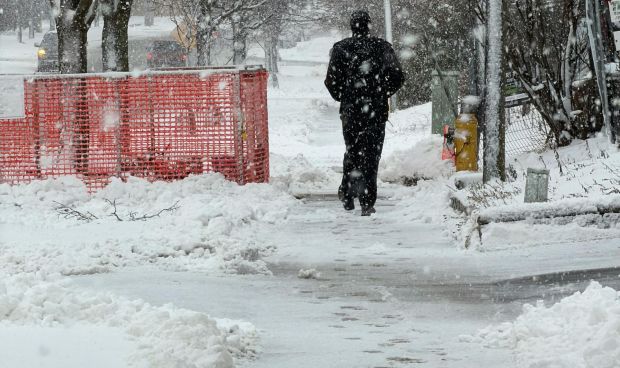
Salt doesn’t just melt ice. It attacks the concrete beneath it through several overlapping mechanisms that most homeowners don’t know about.
First, salt is hygroscopic. it actively draws water into the concrete’s pore structure. Research shows that salt-saturated concrete absorbs up to 10% more water than untreated concrete. More water in the pores means more expansion pressure when that water freezes. Salt literally sets up your concrete for worse freeze-thaw damage than it would otherwise experience.
Second, salt chemically degrades the concrete paste. Calcium hydroxide, a normal byproduct of the cement curing process, reacts with calcium chloride from road salt to form calcium oxychloride. These crystals grow and expand inside the concrete matrix, creating internal pressure that fractures the paste from within. The result is the distinctive gray, flaky scaling you see on Syracuse sidewalks every spring: the top layer of cement paste peeling away to expose the aggregate beneath.
Third, chloride ions corrode steel. In any concrete that contains rebar or wire mesh reinforcement, including many Syracuse residential walkways, chloride ions migrate through the concrete and attack the steel. Steel rust expands, cracking the surrounding concrete from the inside. This is one reason why deteriorated walkways sometimes seem to fall apart suddenly: the interior damage was invisible until the concrete had nothing left to hold it together.
All of this is compounded by the fact that Syracuse roads and sidewalks receive heavy salt applications from November through March, sometimes multiple times per week during an active winter. The cumulative chemical exposure over 10 or 15 winters on a standard concrete walkway is substantial.
What this means for your walkway:Â Rock salt on or near your private walkways accelerates deterioration significantly. Sand provides traction without chemical damage. A penetrating concrete sealer applied every few years creates a barrier that slows chloride penetration. And when replacement is needed, specifying the right concrete mix matters enormously which brings us to the next point.
Not all concrete is the same. A standard residential mix poured without regard for freeze-thaw exposure will fail noticeably faster in Syracuse than properly specified concrete, sometimes within three to five winters. Two specifications make the critical difference in Central New York:
Air-entrained concrete has microscopic air bubbles deliberately introduced into the mix during batching. When water in the surrounding paste freezes and expands, these tiny bubbles act as relief valves; the expanding ice has somewhere to go without fracturing the paste walls.
The American Concrete Institute (ACI) recommends 5-7% air content for exterior concrete exposed to freezing and thawing. The ACI notes that the freeze-thaw resistance of properly air-entrained concrete is improved by several hundred percent compared to non-air-entrained concrete. This is not a minor upgrade. It is the difference between a walkway that lasts 25 years and one that needs replacing after eight.
Michigan Concrete Association guidelines, and industry practice for cold-climate states, call for a minimum of 4,000 PSI compressive strength for exterior flatwork exposed to cyclic freezing and thawing. Standard residential concrete is often batched at 3,000 PSI. In a place like Charlotte or Dallas, that’s fine. In Syracuse, it’s underpowered.
Higher PSI means a denser, less porous concrete matrix. Less porosity means less water absorption, which means less freeze-thaw damage and slower chloride penetration. The cost difference between a 3,000 PSI and 4,000 PSI mix is modest. The difference in service life in CNY conditions is substantial.
What this means for your walkway: When getting quotes for a new pour or replacement, ask specifically: “What PSI mix are you using, and is it air-entrained?” A Syracuse concrete contractor who can’t answer that question clearly or who dismisses it is a contractor to be cautious about. Ask us about our winter-rated concrete mixes specified for Central New York conditions.
The problem isn’t just what’s happening at the surface. The ground beneath your walkway is moving every winter and in much of Onondaga County, the soil type makes that movement worse than average.
Clay soils which are common in Camillus, Baldwinsville, North Syracuse, and throughout Onondaga County are what engineers call frost-susceptible. When temperatures drop, clay doesn’t just freeze passively. It actively draws moisture upward from deeper in the ground through capillary action, a process called “cryosuction.” That moisture accumulates in layers just below the frost line and freezes into lens-shaped ice formations called ice lenses.
Ice lenses grow as long as water is available and temperatures stay below freezing. As they thicken, they push the soil and the concrete slab sitting on top of it upward. This is frost heave. A panel that was flush with its neighbors in October can be sitting an inch or more above them by February.
When temperatures warm, the ice lenses melt. But the soil doesn’t always return to its original position. Ground that was compacted over years can shift slightly with each heave-thaw cycle. Over several winters, panels that were once level develop permanent steps and tilts, the classic Syracuse sidewalk profile.
The solution isn’t just about the concrete on top. A properly prepared sub-base of typically 4–6 inches of compacted crushed stone breaks the capillary connection between the surface and the frost-susceptible clay beneath. It allows water to drain away rather than accumulate and freeze. Skipping this step is the most common cost-cutting shortcut in budget concrete work, and it’s what most often explains why a relatively new walkway is already heaving.
What this means for your walkway:Â If your replacement or new pour doesn’t include proper sub-base preparation, you’re likely to see the same heaving problem again within a few winters. Always ask your contractor: “How are you preparing the sub-base, and what depth of aggregate are you installing?”
Syracuse’s urban tree canopy is one of the city’s most valued assets. It’s also one of the leading causes of sidewalk and walkway damage in older neighborhoods like Strathmore, Eastwood, Sedgwick, and the Near Eastside.
Street trees planted decades ago now have root systems that extend far beyond the visible drip line. Roots follow the path of least resistance and a concrete slab with a small gap at the joint or edge is an easy target. As roots grow thicker year over year, they exert upward pressure against the underside of the concrete panel. Unlike frost heave, which cycles with the seasons, root pressure is continuous and cumulative. The lift gets worse every year, not just every winter.
Root-heaved panels create some of the most severe trip hazards found on CNY properties. A root that has been growing for five or ten years can lift a panel by two, three, or even four inches, well beyond the half-inch legal threshold, and well into the territory where a fall is likely to cause serious injury.
In Syracuse, concrete damage caused by tree roots also complicates repair options. A panel lifted purely by frost heave may be a candidate for mudjacking or foam leveling, lifting it back into position is often practical and cost-effective. A panel lifted by a living root system is different: the root will continue growing, and the panel will continue rising. In most root-damage cases, the right solution is removal of the offending root segment (with proper permits where city trees are involved) and a full replacement pour.
What this means for your walkway: If you have mature street trees near your walkway, inspect annually. Root lift that’s caught early at one-half inch is far cheaper to address than root lift that’s been ignored for three years. See our guide on Mudjacking vs. Full Replacement for a clear framework on when lifting is appropriate versus when a new pour is the only real fix.
These five mechanisms rarely operate in isolation. Here’s how a typical CNY walkway deteriorates over a decade:
This isn’t a worst-case scenario. It’s a description of thousands of properties across Onondaga County right now.
Knowing the mechanisms gives you practical power over them:
Ready for an honest assessment? A-Z Construction & Restoration has been working in Syracuse and Onondaga County since 1986. We know these soils, these trees, and these winters. If you’d like a free walkway inspection and a straight answer about what you’re dealing with, we’re ready. Schedule your free estimate or call 315-488-5292. Monday through Saturday, 7 AM to 7 PM.
This guide is for general informational purposes only. Concrete specifications and best practices referenced reflect industry standards as of 2026. Consult a licensed concrete and masonry contractor for project-specific guidance.