A-Z Construction & Restoration

Why Resurfacing Is the Right Answer for Most Syracuse Garage Floors
If you’ve submitted an inquiry to us that sounds anything like “My garage floor is crumbling badly near where the overhead door comes down, there’s pitting throughout, and I have one crack,” you are in the right place.
That is one of the most common patterns we see on garage floors across the Syracuse area. And in most cases, it’s a resurfacing job, not a full slab replacement. This post explains the difference, helps you figure out which category your floor falls into, and covers what resurfacing costs in Central New York, including some small commercial applications that often fly under the radar.
What Is Concrete Resurfacing? (And What It Isn’t)
Resurfacing often gets confused with two other things, patching and epoxy coating. They are related but not the same.
Patching fills specific spots: a crack here, a spalled area there. It’s targeted, not comprehensive. Epoxy coating goes on top of the concrete as a protective and decorative layer. It is excellent for sealing a surface that is structurally intact and cosmetically acceptable. But it doesn’t fill in widespread pitting, level rough surfaces, or address surface scaling. It follows the contours of whatever is underneath it.
Resurfacing is a bonded concrete overlay, typically a polymer-modified mortar applied across the entire floor surface. It bonds chemically and mechanically to the existing slab, fills in the pitting and scaling, and gives the floor a new, uniform surface. In many cases, it’s the right middle path between spot patching (not enough coverage) and full slab replacement (more than necessary).
The key word is bonded. A resurfacing product that isn’t properly installed, on a poorly prepped or structurally compromised slab, will delaminate. That’s the failure mode to avoid, and it’s why surface preparation and slab evaluation matter as much as the product itself.
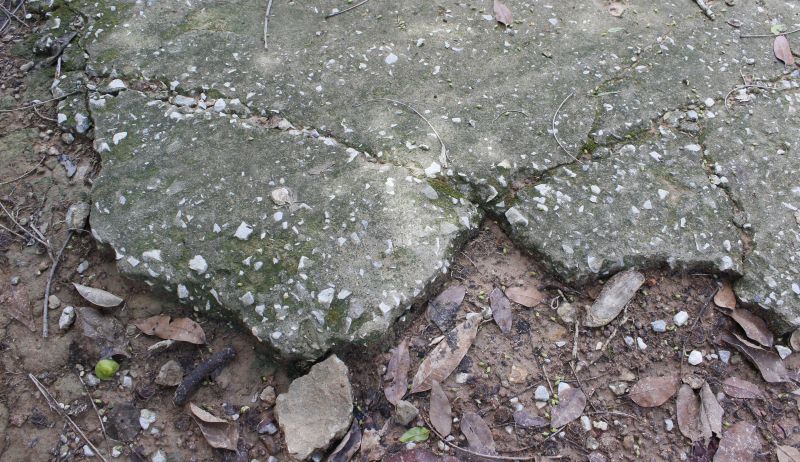
The Three-Problem Scenario: Crumbling Edge, Pitting, and a Crack
Let’s walk through the exact combination of symptoms that shows up most often in the inquiries we receive.
1. Crumbling or Spalling Near the Overhead Door
The zone directly inside the overhead door is the hardest-hit area of any garage floor in Onondaga County. Every winter, vehicles pull in tracking road salt, slush, and melting snow and that material concentrates at the door threshold. The freeze-thaw cycle does the rest: moisture infiltrates the concrete surface, freezes, expands, and breaks the surface aggregate apart from the inside out. Over multiple winters, the top layer of the concrete flakes and crumbles away. This is called spalling, and it is a surface condition, not a structural one as long as it has not progressed too deep into the slab.
Resurfacing addresses spalling directly. The overlay fills in the lost surface material and once cured, provides a harder, denser surface layer than the original concrete at that age.
2. Pitting Throughout the Floor
Widespread pitting, a rough, pocked surface across the whole slab, is scaling caused by salt damage. Sodium chloride doesn’t just sit on your floor; it draws moisture into the concrete’s pore structure and chemically attacks the cement paste that holds the aggregate together. The result is a surface that looks like it has been sandblasted from the inside: irregular, rough, and increasingly difficult to clean.
Pitting that covers most of the floor is exactly the scenario where resurfacing outperforms patching. You cannot practically patch dozens of square feet of pitted surface. The repair area is the whole floor. A bonded overlay addresses it uniformly.
3. One Crack
A single crack, depending on its width and depth, may or may not be a structural concern. Here is how we think about it:
- Hairline or surface crack (under 1/8″): Likely a shrinkage or surface crack. Often injectable or fillable with a flexible polyurethane or epoxy product before resurfacing goes on top.
- Mid-range crack (1/8″ to 1/4″): Needs evaluation for depth and movement. If the two sides of the crack are at the same level and the crack isn’t actively moving, it can typically be stabilized before resurfacing.
- Wide or deep crack (over 1/4″, or with vertical displacement): A more serious structural signal. If the crack runs through the full depth of the slab or one side is higher than the other, resurfacing alone isn’t the answer. The underlying cause needs to be addressed first.
In the scenario described, crumbling edge, widespread pitting, and one crack, the crack usually gets repaired as a first step, then the resurfacing overlay goes on over the prepared slab. The result is a floor that looks and functions uniformly, without the patchwork appearance of spot repairs.
Is Your Slab a Resurfacing Candidate?
Resurfacing works when the underlying slab is structurally sound. The overlay depends on the slab for its support. It is not a structural layer itself. Here is a practical framework:
Resurfacing Is Usually the Right Call When:
- Surface scaling, pitting, or spalling covers a large portion of the floor
- Cracks are surface-level or under 1/4″ wide with no vertical displacement
- The slab is solid underfoot with no hollow or soft spots
- The sub-base hasn’t shifted or eroded (sections are level relative to each other)
- The slab is fewer than 25 years old with isolated surface damage
- You want a uniform appearance without the cost of full replacement
Full or Partial Replacement Makes More Sense When:
- Cracks run through the full depth of the slab
- Sections are heaved, sunken, or displaced relative to each other
- There are hollow or soft spots when you walk the slab
- The sub-base has failed (drainage issues, significant settling)
- Damage covers the majority of the slab at structural depth
- The cost to properly prepare the slab for resurfacing approaches the cost of replacement
When we come out for a free estimate, we will walk the slab, assess crack depth and width, check for hollow spots, and give you an honest answer about which category your floor falls into. If a full replacement is warranted, we will tell you and explain exactly why.