A-Z Construction & Restoration

You’re standing in your basement and the wall looks wrong. It’s not straight anymore. There’s a crack running horizontally across it, or the center of the wall seems to be pushing toward you. You are trying to figure out how bad this actually is and whether you need a repair or a rebuild.
That decision matters more than most homeowners realize. Stabilizing a basement wall at the right time costs a fraction of what replacement costs. Waiting too long removes that option entirely. This guide gives you the framework to understand what you’re looking at, what it means structurally, and what A-Z Construction will recommend when we come out for a free basement wall stabilization inspection.
What “Bowing” Actually Means for Your Foundation
A basement wall bows when lateral pressure from the surrounding soil exceeds the wall’s structural resistance. The wall doesn’t crack first and then bow. It deflects incrementally over time, often over years, before a homeowner notices it.
The pressure source in most Syracuse-area homes is a combination of hydrostatic pressure (water-saturated clay soil pressing against the wall) and frost heave (that same water freezing and expanding inside the clay during our 60+ annual freeze-thaw cycles). Onondaga County’s heavy clay soil retains moisture far longer than sandy or loam soils, which is why bowing walls are common here and less common in areas with better-draining soil.
What you are measuring when you assess a bowing wall is the amount of inward deflection, how many inches the midpoint of the wall has moved from its original position. That number determines everything: which repair method is viable, how urgent the timeline is, and whether stabilization is still on the table.
The Key Number: 2 Inches
Two inches of inward deflection is the widely accepted threshold in structural masonry repair. Walls that have moved less than 2 inches can typically be stabilized without excavation. Walls beyond 2 inches require a more involved assessment. Walls beyond 4 inches are often candidates for replacement. Measure from the face of the wall at its straightest point to the farthest point of the bow.
The Four Stages of Wall Movement and What Each One Means
Stage 1: Hairline Cracking, No Deflection
Vertical or diagonal cracks appear but the wall is still plumb. This is the earliest warning sign. The concrete is yielding to pressure but hasn’t moved yet. At this stage, crack injection (epoxy or polyurethane, depending on whether the crack is structural or wet) is the correct repair. No further basement wall stabilization is generally needed. This is the cheapest point of intervention.
Stage 2: Early Bowing, Less Than 2 Inches
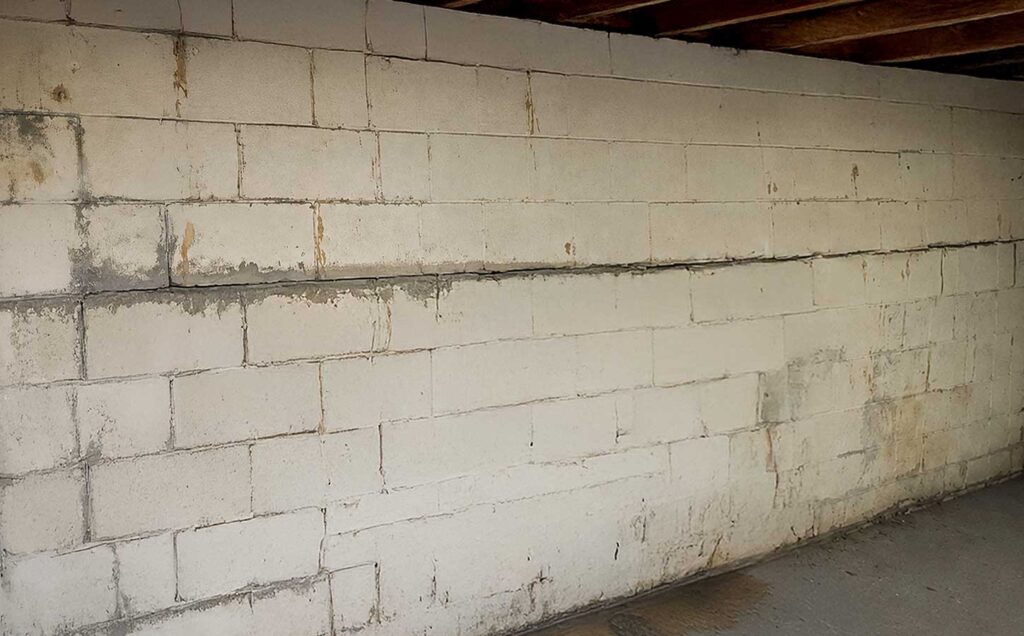
The wall has begun to deflect inward. You may see a horizontal crack at or near the midpoint of the wall. This is the classic sign of lateral soil pressure overcoming the wall’s resistance. The wall is still repairable without excavation.
Carbon fiber straps are the standard solution at this stage. High-tensile carbon fiber straps are bonded vertically to the wall surface, anchored to the floor and ceiling, and permanently prevent further inward movement. They do not restore the wall to its original position, but they stop the progression. Installation requires no excavation and is completed in one visit.
Wall anchors are an alternative, or a complement at this stage. Helical steel plates are driven through the wall and into stable soil outside the foundation, then connected to the wall with steel rods. Wall anchors have one significant advantage over carbon fiber: they can be tightened over time, gradually drawing the wall back toward its original position. If recovering some of the lost position is a priority, anchors are the right choice.
Stage 3: Moderate Bowing, 2 to 4 Inches
At this level of deflection, the wall is under significant structural stress. Carbon fiber straps alone are typically insufficient for basement wall stabilization. The load exceeds what bonded surface straps can reliably carry. Steel I-beam bracing is the primary method: vertical steel beams are installed floor-to-ceiling, transferring the lateral load from the wall to the structural framing of the house.
Wall anchors may still be used at this stage, often in combination with I-beam bracing. The repair is more involved and more costly than Stage 2 intervention, but it is still substantially less expensive than wall replacement. This is the stage where homeowners most often wish they had called sooner.
At 2 to 4 inches, the urgency increases meaningfully. Walls in this range should be assessed and stabilized before the next winter freeze-thaw cycle adds further pressure.
Stage 4: Severe Deflection, More Than 4 Inches or Active Failure
At deflections beyond 4 inches, and in cases where the wall is actively moving or has begun to lose structural integrity at the base or top, replacement may be the only structurally sound option. This means excavating the soil on the exterior, removing and rebuilding the wall, and reinstalling drainage to address the hydrostatic pressure source.
Wall replacement is significantly more expensive and disruptive than any stabilization method. It is also the correct answer when the wall’s structural condition no longer supports repair. A thorough inspection will determine which side of that line your wall sits on.
Why Waiting Is the Most Expensive Decision
A Stage 2 wall stabilized with carbon fiber straps costs a fraction of a Stage 3 steel I-beam repair. A Stage 3 wall addressed now costs a fraction of Stage 4 replacement. Wall movement does not stop on its own. Every freeze-thaw cycle adds pressure. Every spring thaw softens the clay. The decision window is real and it closes.
Comparing the Three Stabilization Methods
| Method | Best for | Excavation? | Restores position? | Relative cost |
|---|---|---|---|---|
| Carbon fiber straps | < 2 inch bow | No | Holds in place | $ |
| Wall anchors | < 2–3 inches, recoverable | Minimal | Yes — gradually | $$ |
| Steel I-beam bracing | 2–4 inch bow | No | Arrests movement | $$$ |
| Wall replacement | > 4 inches or active failure | Yes – Full | Full rebuild | $$$$ |
Signs Your Wall Has Already Crossed a Threshold
Not every homeowner can measure deflection precisely. Here are the observable signs that correspond to each stage, so you know what urgency level applies before you call.
Call within the week:
- Any horizontal crack in a concrete block or poured concrete wall, at any width
- A wall that visibly curves inward when you stand at one end and look down its length
- Doors or windows near the foundation that have recently become difficult to open or close
- Cracks wider than ¼ inch that have grown since you last looked at them
- White mineral deposits (efflorescence) along a horizontal crack line. This indicates sustained water infiltration at the stress point
Schedule soon: Not yet an emergency, but don’t delay:
- Stable vertical or diagonal cracks less than ¼ inch that have not changed in several months
- Minor efflorescence on the lower third of the wall with no visible movement
- A wall that feels slightly “off” but doesn’t have a visible horizontal crack yet
Watch and monitor: Document with photos and dates:
- Hairline vertical cracks that are dry and have been stable for a year or more
- Light staining that appears seasonal and dries out between episodes
When in doubt, schedule a free inspection. Identifying the stage early costs nothing. A-Z Construction offers free carbon fiber strap installation assessments in Syracuse with same-week scheduling for structural concerns.
Why Syracuse Walls Bow More Than Walls in Other Regions
If you have friends in other parts of the country who own similar-age homes and have never dealt with a bowing wall, it’s not because they’re lucky. It is geology and climate.
Onondaga County sits on dense glacial till and clay-heavy soils that retain far more water than sandy or loam soils. After rain or snowmelt, that saturated clay exerts hydrostatic pressure against every basement wall it touches. When temperatures drop below freezing, water molecules in that clay ice up and expand by approximately 9% in volume. That expansion is frost heave, and it pushes laterally against your foundation walls with enormous force.
Syracuse averages more than 60 freeze-thaw cycles per year. That’s 60 cycles of expansion and contraction pressing against your walls, relaxing slightly, then pressing again. Each cycle is small. The cumulative effect over 10, 20, or 30 years is not.
Homes built in the 1950s through 1980s, the majority of the housing stock in Fayetteville, Manlius, DeWitt, Liverpool, Camillus, and the inner-ring Syracuse neighborhoods, are now old enough that this cumulative pressure has had decades to work. It’s why we see so many walls at Stage 2 and Stage 3 in those communities.
A Note on Older Block Foundations
Concrete block (CMU) foundations common in pre-1980 Central New York construction are particularly susceptible to horizontal cracking and bowing because the blocks are stacked and mortared. They lack the monolithic tensile strength of poured concrete. A horizontal crack in a block wall is structurally more serious than in a poured concrete wall of the same apparent severity. If your foundation is block construction, the urgency level for basement wall stabilization is higher at every stage.
What Happens at a Free A-Z Construction Inspection
When John Shinto’s team comes out for a free inspection, we do not arrive with a predetermined answer. We assess the wall material, measure the degree of deflection at multiple points, identify the crack pattern and what it indicates about pressure direction, look for water infiltration paths, and evaluate the soil and drainage conditions on the exterior if accessible.
You receive a written estimate that explains what we found, why we recommend what we recommend, and the full cost. If your wall only needs monitoring, we’ll tell you that too. We have been working in Onondaga County since 1986. Our reputation is built on accurate diagnosis, not on selling the most expensive solution to every problem.
We operate Monday through Saturday, 7 AM to 7 PM. For horizontal cracks or visible wall movement, we offer same-week scheduling. Spring thaw season (March through May) is our busiest period. If you have noticed new movement or cracks after snowmelt, do not wait until summer.
Schedule your free basement wall stabilization assessment in Syracuse →
Frequently Asked Questions
How do I measure how much my basement wall is bowing?
Hold a long straightedge (a level or a straight 2×4) vertically against the wall. The gap between the straightedge and the farthest inward point of the wall is your deflection measurement. Measure at several points along the wall and record the largest reading. If you don’t have a straightedge long enough, a chalk line pulled taut from the top to the bottom of the wall works as well.
Can a bowing wall be fixed without excavating my yard?
In most cases, yes. Carbon fiber straps and steel I-beam bracing are both interior repairs that require no excavation. Wall anchors require driving helical plates through small holes in the wall into the soil outside. This is minimally invasive and does not require open excavation in most installations. Full excavation is only required for sub-grade waterproofing or wall replacement.
Is a bowing wall covered by homeowners insurance?
Typically no. Standard homeowners insurance policies exclude damage from hydrostatic pressure, soil movement, and settling which are the causes of almost all bowing basement walls. Some policies have endorsements for water backup or foundation coverage, but these are the exception. Check your policy’s exclusions section. What insurance generally does cover is sudden, accidental damage, not the gradual movement that causes bowing.
How long does basement wall stabilization take?
Carbon fiber strap installation for a typical residential wall (20–30 linear feet) is usually completed in a single day. Wall anchor installation is also typically a one-day job. Steel I-beam bracing installation takes one to two days depending on the number of beams required. None of these methods require curing time that prevents you from using the basement afterward.
What happens if I do nothing?
Wall movement does not stabilize on its own. The pressure driving it — soil, water, and frost heave — continues every season. A Stage 2 wall left unrepaired will become a Stage 3 wall. A Stage 3 wall will eventually reach the point where replacement is the only option. The cost difference between early stabilization and late-stage repair is significant. The cost difference between late-stage repair and full replacement is even larger.