A-Z Construction & Restoration
📍 Syracuse & Central NY
FALL SPECIAL: Free Foundation & Chimney Inspections
📞 Call Now: 315-488-5292

Foundation Crack Repair · Basement Wall Stabilization · Syracuse, NY
PROTECT YOUR HOME. Foundation Repair & Basement Wall Stabilization in Syracuse, NY
Syracuse’s clay soils and punishing freeze-thaw cycles put relentless pressure on basement walls. A-Z Construction has repaired and stabilized foundations across Central New York since 1986 — Stopping small cracks before they become structural emergencies.
- 38+ YEARS IN CNY
- FREE ESTIMATES
- SAME-WEEK SCHEDULING
Licensed & Insured
NYS Registered Contractor
5-Star Rated
Google - Home Advisor - Angi
Local Family-Owned
Onondaga County Since 1986
Written Warranty
All Repairs Guaranteed
IS YOUR BASEMENT WALL TELLING YOU SOMETHING?
Central New York’s heavy clay soils and relentless freeze-thaw cycles put your foundation under stress year-round. These are the signs homeowners most often overlook until they become expensive structural problems.
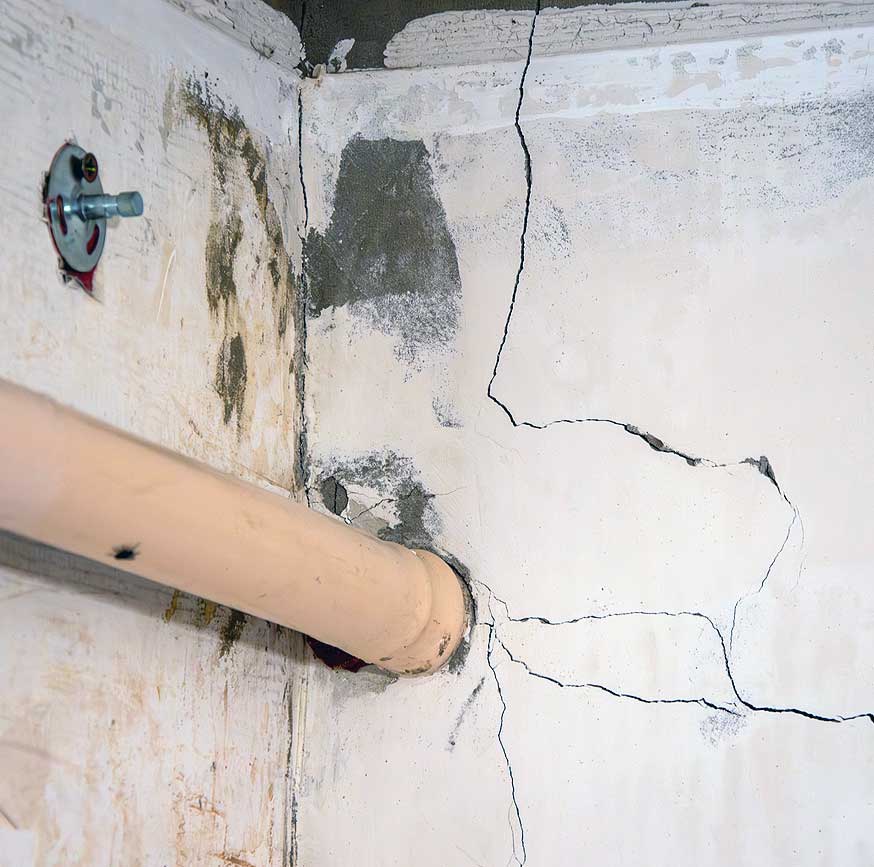
HORIZONTAL CRACKS
The most serious type. Indicates lateral soil pressure bowing the wall inward indicating a potential structural failure requiring immediate stabilization.
VERTICAL OR STAIR-STEP CRACKS WIDER THAN 1/4″
Settlement and movement cracks. When wider than a quarter-inch or actively growing, they need professional assessment and repair before water infiltration begins.
BOWING OR BULGING WALLS
Visible inward movement of a basement wall signals that hydrostatic pressure has overcome the wall’s structural capacity. Wall anchors or carbon fiber straps are typically required.
WATER SEEPING THROUGH WALLS
Post-rain or snowmelt moisture entering through cracks. Left unaddressed, water infiltration accelerates deterioration and leads to mold, efflorescence, and wall failure.
WHITE CHALKY RESIDUE (EFFORESENCE)
Mineral deposits left when water migrates through concrete. A clear indicator of active water movement through your foundation walls.
STICKY DOORS OR WINDOWS
When frames rack out of square, it often signals foundation movement or structural settlement affecting the structure above — not just a humidity problem.
GAPS BETWEEN WALLS, FLOORS OR CEILING
Separation at wall-to-floor or wall-to-ceiling junctions indicates shifting or settling that requires a structural assessment.
MUSTY SMELL OR VISIBLE MOLD
Persistent moisture from foundation cracks creates ideal conditions for mold growth. Resolving the crack is the first step, not just remediation.
Any horizontal crack or vertical crack wider than ¼ inch should be inspected immediately.
STRUCTURAL MASONRY REPAIR
FOUNDATION CRACK REPAIR IN SYRACUSE, NY
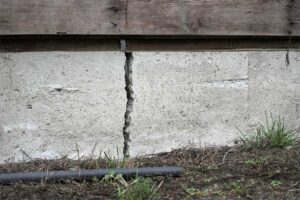
THE RIGHT REPAIR DEPENDS ON THE RIGHT DIAGNOSIS. Not every crack is what it appears to be.
A-Z Construction has provided foundation crack repair in Syracuse, NY since 1986. We diagnose the type and cause of every crack before selecting a repair method, because the wrong material fails within a season.
A hairline shrinkage crack and a horizontal pressure crack look similar to the untrained eye and require completely different interventions. Getting this diagnosis right is the difference between a one-visit repair and a recurring problem.
- Epoxy injection — For structural, load-bearing cracks in walls that are still in position. Epoxy bonds the crack faces together, restoring structural continuity. Used when the crack is dry or only intermittently damp and the wall has not deflected.
- Polyurethane foam injection — For active water-infiltrating cracks. Polyurethane expands on contact with moisture, filling the crack and creating a flexible waterproof seal. The right choice when water is actively entering; the wrong choice for structural cracks where rigidity is needed.
- Hydraulic cement — For active leaks and large voids where water is flowing at the time of repair. Sets rapidly under wet conditions. Used as a first-response measure before a permanent injection repair.
- Structural limestone repair — For older Syracuse-area homes built on cut stone or rubble stone foundations, which require a different approach than poured concrete or concrete block. A-Z has specific experience with the pre-1950 foundation stock common in Onondaga County.
Foundation Crack Repair Costs in Syracuse, NY
The cost of foundation crack repair in Syracuse varies significantly based on crack type, length, number of cracks, and whether water infiltration or structural movement is involved.
A single epoxy injection repair for a stable hairline crack is among the most affordable structural repairs a homeowner can make.
Polyurethane repairs for active water infiltration are in a similar range. Hydraulic cement applications for large active leaks cost more, and repairs involving multiple cracks or significant void filling are priced per crack after inspection.
All estimates are provided in writing at no charge. There are no hidden fees and no pressure to proceed.
STRUCTURAL MASONRY REPAIR
BASEMENT WALL STABILIZATION IN SYRACUSE, NY
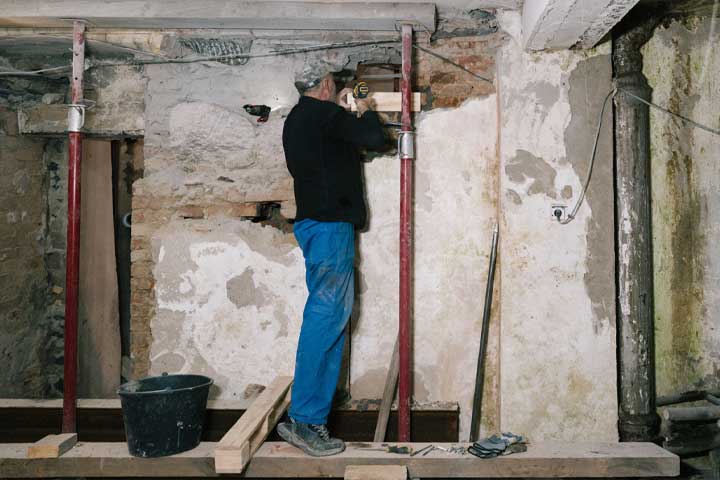 Basement wall stabilization is a structural repair method for foundation walls that have moved beyond cracking into bowing, leaning, or lateral displacement. Where crack injection seals a fracture in a wall that is still plumb and in position, stabilization physically arrests a wall that has shifted inward due to soil pressure.
A-Z Construction has stabilized basement walls across Syracuse and Onondaga County since 1986, using carbon fiber straps, wall anchors, and steel I-beam bracing depending on the severity
of movement.
When Stabilization is Necessary
- Your wall has a horizontal crack (the most serious type – indicates lateral
soil pressure actively bowing the wall inward)
The wall has visibly moved inward, even slightly - Cracks are wider than 1/4 inch and growing
- Doors or windows near the foundation are racking out of square
- You can see a bow or curve when you look down the length of the wall
When crack injection alone is sufficient:
- The crack is hairline, dry, and stable (not growing)
- The wall is still straight and plumb
- No horizontal cracks are present
- The crack is vertical or diagonal with no wall movement
Stabilization Methods
A-Z Construction selects the stabilization method based on wall material, degree of inward deflection, and the soil pressure source. We never apply a one-size-fits-all solution. The wrong method for your wall type can accelerate failure.
- Carbon fiber straps: For walls that have bowed inward up to 2 inches. Permanently bonded to the wall surface, they prevent further movement without excavation.
- Wall anchors: Helical plates driven into stable soil outside the foundation, tied back to the wall with steel rods. Can be tightened over time to gradually restore the wall toward its original position.
- Steel I-beam bracing: For severe lateral movement or walls under active ongoing soil pressure. Spans floor to ceiling and transfers the load to structural framing.
- Sub-grade waterproofing: Addresses the hydrostatic source driving the pressure, not just the symptom. Often paired with stabilization on walls showing active water infiltration.
Central New York’s heavy clay soils make basement wall movement a common problem in Syracuse-area homes. Onondaga County clay retains water after rain and snowmelt, building hydrostatic pressure against foundation walls. When temperatures drop, that water freezes and expands up to 9% in volume, a force called frost heave, amplifying lateral pressure against the wall repeatedly across 60+ freeze-thaw cycles every winter. Most walls don’t fail overnight. They deflect incrementally over years. Catching movement at the 1-inch stage costs a fraction of what a 2-inch bow requiring I-beam bracing costs, and a fraction of full wall replacement.
THE SCIENCE BEHIND IT
Why Central New York foundations crack & walls move
It’s not bad construction. It’s Syracuse’s soil and climate working against your foundation every single winter.
- HEAVY CLAY SOIL RETAINS WATER
Onondaga County sits on dense clay that doesn’t drain well. After rain or snowmelt, this saturated soil presses against your basement walls, a force called hydrostatic pressure. - FREEZE-THAW CYCLES EXPAND THE PRESSURE
Water in that clay freezes, expanding up to 9% in volume. This frost-heave creates enormous lateral force against your walls repeatedly, all winter. Syracuse averages over 60 freeze-thaw cycles per year. - CRACKS FORM, THEN WALLS BEGIN TO BOW
The concrete yields first as small cracks, often vertical. As pressure continues season after season, those cracks widen and the wall may begin to deflect inward to the point where crack repair gives way to stabilization. - EARLY ACTION IS DRAMATICALLY CHEAPER
A hairline crack repaired with epoxy costs a fraction of what a bowed wall requiring steel bracing costs. A bowed wall addressed early costs a fraction of a full wall replacement. The decision window matters.
THE FAILURE SEQUENCE
FREE ESTIMATES. SAME-WEEK SCHEDULING. CALL 315-488-5292
FROM YOUR FIRST CALL TO A WARRANTED REPAIR
01
Call or Schedule Online
Reach us at 315-488-5292 or use the form below. We offer same-week scheduling for structural concerns. Mon–Sat, 7 AM to 7 PM.
02
Free Onsite Inspection
A structural masonry specialist visits your property. We assess crack type, wall movement, water infiltration, and soil pressure, not just what’s visible.
03
Written Estimate, No Pressure
You receive a detailed written estimate explaining the problem, recommended repair method, and the cost. No obligation or surprise add-ons.
04
Repair & Written Warranty
Work is completed by our own crew. Never subcontracted. Every repair comes with documented warranty coverage and a follow-up contact to confirm your satisfaction.
Real Results Across Syracuse & Onondaga County
Read what Central NY Homeowners Say
Posted on Google
 Antonio Andrews22 days ago
Trustindex verifies that the original source of the review is Google.
A-Z construction & Restoration, did a great job on my foundation on my house and steps in my back yard. My wife and I love what they did. Very professional, I would recommend this company to anyone. Thank you.Posted on Google Ryan Myers25 days agoJohn and crew did a great job pouring a concrete walkway and restoring some concrete steps. John was easy to work with and offered some suggestions to meet my needs. He was able to begin the job earlier than expected which was greatly appreciated. I'd highly recommend A-Z Construction & Restoration.Posted on Google
 Steve Swift29 days agoJohn did a great job re-pointing out 100 year old brick house. He also rebuilt the upper section of the chimney. And last but not least they did a wonderful job repairing the collapsing cellar window wells. I highly recommend them.Posted on Google
 James McNeal158 days agoJohn and the crew were very informative on what was needed and very professional throughout the project. Would recommend them.Posted on Google
 Rosemary Izyk171 days agoJohn and his crew did an awesome job. Also had great advise for future maintenance.Posted on Google
 david webb171 days agoJohn and his team have done multiple improvements as well as some needed repairs for me over the past 30 years. Always proffesional and courteous . Wouldn’t call anyone else!!! Thanks John…..Posted on Google
 Christopher Holmes191 days agoMy home was built in 1940 and has a stone chimney. I called A-Z Construction & Restoration when noticed some mortar missing. John and his crew repaired the missing mortar and fixed the cracks in the chimney cap. They also repointed the stone work around my house. I am very pleased with the work they did . I am sure the repairs saved my home from much more serious damage and It was completed fast and at a reasonable price.Posted on Google
 Mary Ellen Fix196 days agoI hired John Schinto of A-Z Construction after he was highly recommended to me by 2 of my neighbors who raved about his work. My back concrete steps leading to my yard were severely chipped and deteriorated which I thought were beyond repair. John resurfaced them with brick pavers and concrete in a classic design which actually matched my front walkway exactly. The steps actually look new. I’m so very pleased with his workmanship, price and friendly manner and highly recommend him for all your home stone, brick and concrete projects. True quality craftsmanship!!!!Posted on Google
 Chester Gural212 days agoJohn along with his son & crew did a great job on my chimney rebuild. It was badly deteriorated as the house was built in 1900. Immediately following their work I had a total roof replacement by another company. When they came back to put a cap on the chimney, they were very careful as to not damage the new shingles. Very reasonable pricing, very professional & nice guys to work with. Would highly recommend! Chester GuralPosted on Google
 Will217 days agoI needed to get some concrete stairs at my house repaired. I asked a couple of my friends if they knew anyone and both of them recommended A-to-Z construction and restoration. So I decided to give them a try. What a great job they did. Beyond my expectations, everything was clean and taken care of when they left. I got a lot of compliments on how well they looked. So when I needed some more work done there was only one call to make… A-to-Z ConstructionVerified by TrustindexTrustindex verified badge is the Universal Symbol of Trust. Only the greatest companies can get the verified badge who has a review score above 4.5, based on customer reviews over the past 12 months. Read more

We are proud of our consistent 5-star reviews, and even prouder of the trust our customers place in us.
FOUNDATION REPAIR FAQ - THE QUESTIONS WE ARE ASKED
What is Basement Wall Stabilization and Do I Need It?
What is Basement Wall Stabilization and Do I Need It?
Basement wall stabilization is a repair method used when a foundation wall has begun to bow, lean, or shift inward, not just crack. Standard crack injection addresses fractures in a wall that is still straight and plumb. Stabilization is necessary when the wall has actually deflected from its original position due to lateral soil pressure.
Common stabilization methods include carbon fiber straps (for walls bowed less than 2 inches), wall anchors (helical plates driven into stable soil and tied back to the wall), and steel I-beam bracing for severe movement. If your wall has a horizontal crack or is visibly bowing, you likely need stabilization. A free inspection will confirm which applies.
How Do I Know if My Foundation Crack is Structural?
How Do I Know if My Foundation Crack is Structural?
Two immediate red flags: any horizontal crack in a block or poured concrete wall, and any crack wider than ¼ inch. Both should be inspected without delay. Stair-step cracks in block walls and diagonal cracks running from corners of window or door openings can also indicate settlement or movement rather than normal concrete shrinkage.
Hairline vertical cracks that are dry, stable, and haven’t grown are often normal concrete shrinkage and may only need monitoring or a cosmetic seal. When in doubt, call us — the inspection is free and takes the guesswork out of it.
What is the Difference Between Crack Injection and Wall Stabilization?
What is the Difference Between Crack Injection and Wall Stabilization?
Crack injection (epoxy or polyurethane) fills and seals a crack in a wall that is otherwise stable and in its original position. It restores the wall’s integrity and stops water infiltration. Think of it as stitching a wound. It works when the underlying structure is sound.
Wall stabilization addresses movement. When a wall has deflected inward due to soil pressure, injection alone doesn’t resolve the cause. Stabilization physically arrests further movement and, with wall anchors, can sometimes allow gradual restoration to the original position. Most projects use one method or the other; some use both.
What is the difference between foundation repair and basement wall stabilization?
What is the difference between foundation repair and basement wall stabilization?
How do I find a reputable foundation repair contractor in Syracuse, NY?
How do I find a reputable foundation repair contractor in Syracuse, NY?
How Does Syracuse's Freeze-Thaw Cycles Damage Foundations?
How Does Syracuse's Freeze-Thaw Cycles Damage Foundations?
Onondaga County sits on heavy clay soils that retain significant moisture. During winter, water in that saturated clay freezes and expands up to 9% in volume creating lateral “frost-heave” pressure against your foundation walls. This happens repeatedly across more than 60 freeze-thaw cycles in an average Syracuse winter.
Over time, that cumulative pressure causes small cracks to widen, straight walls to begin bowing inward, and water infiltration paths to open up each spring. Homes built on or near clay-heavy lots, common throughout the Syracuse metro area, are particularly susceptible.
How Much Does Foundation Crack Repair Cost in Syracuse?
How Much Does Foundation Crack Repair Cost in Syracuse?
Cost varies significantly based on the type of crack, number of cracks, length, and whether water infiltration or structural movement is involved. A simple epoxy injection repair for a single hairline crack is very affordable. Wall stabilization with carbon fiber straps or wall anchors is a larger investment, but still a fraction of full wall replacement.
We provide free, written estimates with no obligation. The estimate will specify the exact repair method, why we recommend it, and the full cost. No hidden fees or post-job surprises.
How Quickly Can You Schedule an Inspection?
How Quickly Can You Schedule an Inspection?
For structural concerns – horizontal cracks, visible wall movement, active water infiltration – we prioritize same-week scheduling. We operate Monday through Saturday, 7 AM to 7 PM. For non-urgent assessments, we typically book within 7-10 days.
The spring thaw period (March through May) is our busiest season. If you’re seeing new cracks or moisture after snowmelt, call us early rather than waiting. Our schedule fills quickly once temperatures rise.
SERVING SYRACUSE AND ALL OF ONONDAGA COUNTY
We’re a local crew, not a national franchise. Every job in our service area is handled by the same team, with the same standards.
We service Syracuse and Onondaga County and surrounding communities, including Fayetteville, Manlius, DeWitt, Jamesville, Liverpool, Clay, Camillus, Solvay, North Syracuse, and East Syracuse. We also regularly serve Cazenovia, Nelson, Chittenango, and other Madison County communities to the east.
We know the soils, the neighborhoods, and the specific challenges that Central New York winters create for foundations and basement walls.
Call 315-488-5292 to get your FREE inspection today.