A-Z Construction & Restoration

Sidewalk Liability in New York: The Law Every Property Owner Needs to Know
You walk past your front walkway every day. It’s been cracked for a while. Maybe since last winter, maybe longer. You’ve noticed it, made a mental note, and figured you’d deal with it eventually. Then one afternoon a neighbor trips on it, goes down hard, and ends up in the ER with a broken wrist.
Are you liable? In New York, the answer is almost certainly yes, and the law regarding sidewalk liability in New York doesn’t care that you hadn’t gotten around to fixing it yet.
This guide explains how sidewalk liability works in New York, what the legal concept of constructive notice means for property owners, and why waiting is almost always the more expensive choice.
Note: This article provides general legal information for educational purposes. It is not legal advice. If you are facing a specific liability situation, consult a licensed New York attorney.
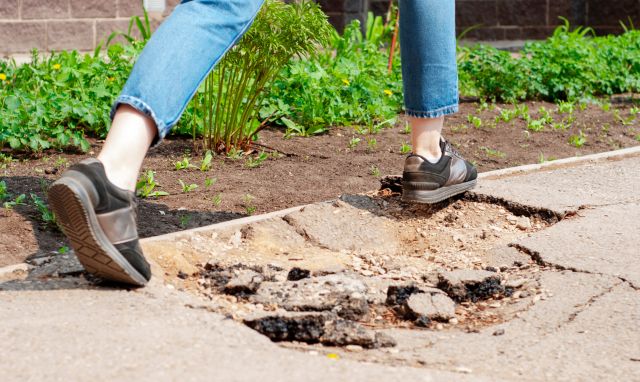
The Law in Plain English: You Are Responsible
New York law, specifically NYC Administrative Code §7-210, which sets the standard applied across New York State courts, places a clear duty on property owners: you must maintain the sidewalk and walkway adjacent to your property in a reasonably safe condition.
That duty covers:
- Repairing cracked, broken, or uneven concrete panels
- Addressing trip hazards caused by frost heave or tree root uplift
- Removing snow and ice within a reasonable time after a storm
- Fixing improperly sloped surfaces that pool water and refreeze
- Correcting any raised hardware, grates, or utility covers above the walking surface
And here’s what makes this law particularly significant: the duty is non-delegable. That means you cannot hand it off. If you hire a property manager, assign a tenant to handle maintenance, or contract a repair company and something still goes wrong, you remain the legally liable party. Courts have consistently ruled that property owners cannot escape responsibility by pointing to someone else.
What Is Constructive Notice and Why It’s a Problem for Most Homeowners
There are two ways you can be considered legally “on notice” of a hazardous condition.
Actual notice is straightforward: someone told you about the problem. A neighbor complained, a tenant submitted a maintenance request, the city issued a violation, or you personally observed the defect. From that moment, the clock is ticking.
Constructive notice is where most property owners get caught out. The law says that if a dangerous condition existed long enough that a reasonable property owner conducting regular inspections would have discovered it, you are considered to have known about it. You don’t actually have to have seen it. The defect’s existence over time creates the legal presumption that you should have.
In practice, this means:
- A heaved panel that’s been lifting since last spring? You’re on constructive notice.
- A crack that’s been widening for two winters? You’re on constructive notice.
- Tree root damage that’s been visible for years? You’re on constructive notice.
Evidence that a condition persisted for months or years is typically sufficient to establish constructive notice in New York courts. Dated photographs, DOT violation records, 311 complaint logs, and maintenance records can all be used to demonstrate how long a hazard existed and courts take that evidence seriously.
“I didn’t know it was that bad” is not a defense. New York courts have explicitly held that a property owner’s subjective belief that a condition is not dangerous is insufficient to avoid liability. The standard is objective: what a reasonable person conducting reasonable inspections would have found.
The ½-Inch Rule: Where the Line Is Drawn
New York Administrative Code §19-152 gives property owners a specific, measurable standard to work from. A legal trip hazard exists when:
- The vertical gap between two adjacent sidewalk panels is ½ inch or greater
- A surface defect is 1 inch or more in horizontal area and ½ inch or more deep
- A panel is loose, rocks, or seesaws underfoot
- There is a visible void beneath a panel (it has been undermined)
Half an inch is roughly the thickness of a pencil. It’s not a dramatic crack. It’s the kind of thing that’s easy to walk past a hundred times without thinking twice but it’s the legal threshold at which a court will hold you strictly liable if someone is injured, provided you had actual or constructive notice of the condition.
The courts don’t require a perfect sidewalk. For sidewalk liability in New York, what they require is reasonable maintenance and a response to known hazards. The ½-inch rule gives you a clear signal: once a gap or elevation change reaches that point, it needs to be addressed promptly.
CNY-Specific Hazards: Ice Heaves and Tree Roots as Legal Traps
Two hazards are particularly common in Syracuse and Onondaga County and both are legally actionable.
Ice heave and frost damage
Central New York’s clay soils and aggressive freeze-thaw cycles cause sidewalk panels to lift and shift every winter. A panel that was flush in October may be sitting ½ inch or more above its neighbor by April. Property owners who walk past this damage daily and take no action are establishing exactly the kind of constructive notice record that plaintiffs’ attorneys look for. The seasonal and predictable nature of frost heave in Syracuse makes it very difficult to claim you had no reason to expect it.
Tree root uplift
Syracuse’s mature street trees push roots beneath walkway panels year after year, lifting them progressively. Unlike frost heave which can happen quickly, root damage develops slowly and visibly. That slow, visible progression is precisely what constructive notice is designed to capture. A root-heaved panel that has been rising for two or three seasons is one of the clearest examples of a condition you should have found and fixed.
It’s worth noting that the City of New York’s Parks Department operates a Trees & Sidewalks Program that can help qualifying residential property owners with root damage repair. In Syracuse, contact the Department of Public Works to understand your options. But the existence of a potential city program does not suspend your liability in the meantime. If someone is injured before a repair is made, the legal exposure is yours.
For a full breakdown of when leveling can save a root-heaved panel versus when a full replacement is required, see our guide: Mudjacking vs. Full Replacement: What’s Best for Your Sunken Walkway?