A-Z Construction & Restoration

📍 Syracuse & Central NY

❄️ SPRING THAW SPECIAL: Free Foundation & Chimney Inspections

📞 Call Now: 315-488-5292

Why Syracuse Concrete Fails: 5 Ways Our Winters Destroy Your Walkways

Why Syracuse Concrete Fails: 5 Ways CNY Winters Destroy Your Walkways

Winter Syracuse Concrete Damage ·  Syracuse & Onondaga County  ·  Updated March 2026

Syracuse Concrete Damage: Five Winter Forces Destroying Your Walkways

Syracuse averages more than 100 inches of snow a year, one of the highest totals of any city in the continental United States. But snowfall alone isn’t what destroys concrete. It’s what happens between the snow events: the temperature swings, the road salt, the ground beneath your slab, and the relentless trees pushing up from below.

Understanding Syracuse concrete damage caused by constant freeze-thaw cycles and why concrete fails in Central New York is the first step toward making smarter decisions about concrete repair, replacement, and what to ask your contractor. This guide breaks it down. Each of the five mechanisms below can damage concrete on its own. In Syracuse, all five often work together on the same slab at the same time.


1. Freeze-Thaw Cycling: The Relentless Pressure From Within

Concrete looks solid, but it’s full of tiny pores and capillaries, microscopic channels that absorb water just like a sponge. That’s normal and unavoidable. The problem starts when temperatures drop.

When water freezes, it expands by about 9%. Inside a concrete pore, that expansion has nowhere to go. It pushes outward against the pore walls with forces that can reach thousands of pounds per square inch. The pore widens slightly. When the ice thaws, the water drains away but the crack it created stays larger than before. The next freeze pushes deeper into that now-wider crack. The cycle repeats.

In Syracuse, this doesn’t happen just a few times a season. Temperature data shows the city averages roughly 100 freeze-thaw cycles per winter meaning temperatures cross the 32°F threshold in both directions approximately 100 times between November and April. That’s 100 rounds of internal expansion and contraction, each one slightly worsening damage the previous cycle started.

This is why a sidewalk can look perfectly fine in October and be obviously crumbling by April. This Syracuse concrete damage doesn’t accumulate gradually. It accelerates. Each cycle has more existing cracks to exploit than the one before it.

What this means for your walkway: Any crack that isn’t sealed before winter becomes a water entry point. Water that gets into a crack in October is actively widening it by February. Early crack sealing is the single highest-ROI maintenance task available to a Syracuse property owner.
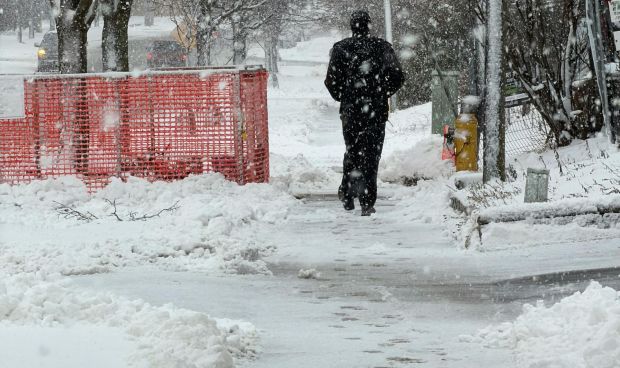
Syracuse concrete damage and repair

2. Road Salt: A Chemical Attack on Your Concrete

Salt doesn’t just melt ice. It attacks the concrete beneath it through several overlapping mechanisms that most homeowners don’t know about.

First, salt is hygroscopic. it actively draws water into the concrete’s pore structure. Research shows that salt-saturated concrete absorbs up to 10% more water than untreated concrete. More water in the pores means more expansion pressure when that water freezes. Salt literally sets up your concrete for worse freeze-thaw damage than it would otherwise experience.

Second, salt chemically degrades the concrete paste. Calcium hydroxide, a normal byproduct of the cement curing process, reacts with calcium chloride from road salt to form calcium oxychloride. These crystals grow and expand inside the concrete matrix, creating internal pressure that fractures the paste from within. The result is the distinctive gray, flaky scaling you see on Syracuse sidewalks every spring: the top layer of cement paste peeling away to expose the aggregate beneath.

Third, chloride ions corrode steel. In any concrete that contains rebar or wire mesh reinforcement, including many Syracuse residential walkways, chloride ions migrate through the concrete and attack the steel. Steel rust expands, cracking the surrounding concrete from the inside. This is one reason why deteriorated walkways sometimes seem to fall apart suddenly: the interior damage was invisible until the concrete had nothing left to hold it together.

All of this is compounded by the fact that Syracuse roads and sidewalks receive heavy salt applications from November through March, sometimes multiple times per week during an active winter. The cumulative chemical exposure over 10 or 15 winters on a standard concrete walkway is substantial.

What this means for your walkway: Rock salt on or near your private walkways accelerates deterioration significantly. Sand provides traction without chemical damage. A penetrating concrete sealer applied every few years creates a barrier that slows chloride penetration. And when replacement is needed, specifying the right concrete mix matters enormously which brings us to the next point.
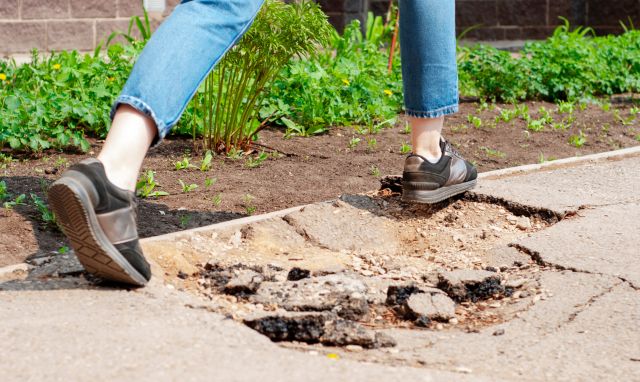
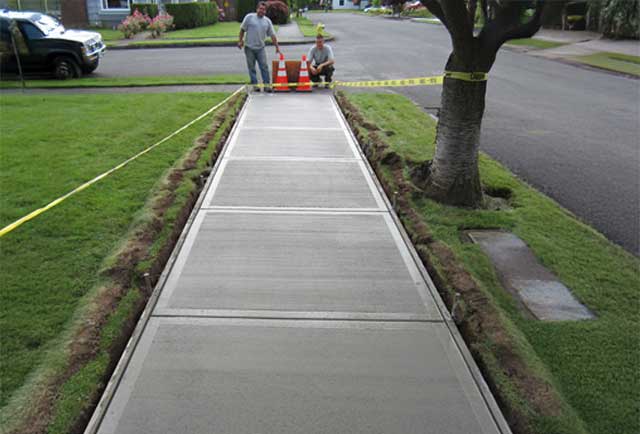
3. The Wrong Concrete Mix: Most Slabs Were Never Built for This Climate

Not all concrete is the same. A standard residential mix poured without regard for freeze-thaw exposure will fail noticeably faster in Syracuse than properly specified concrete, sometimes within three to five winters. Two specifications make the critical difference in Central New York:

Air entrainment

Air-entrained concrete has microscopic air bubbles deliberately introduced into the mix during batching. When water in the surrounding paste freezes and expands, these tiny bubbles act as relief valves; the expanding ice has somewhere to go without fracturing the paste walls.

The American Concrete Institute (ACI) recommends 5-7% air content for exterior concrete exposed to freezing and thawing. The ACI notes that the freeze-thaw resistance of properly air-entrained concrete is improved by several hundred percent compared to non-air-entrained concrete. This is not a minor upgrade. It is the difference between a walkway that lasts 25 years and one that needs replacing after eight.

Compressive strength (PSI)

Michigan Concrete Association guidelines, and industry practice for cold-climate states, call for a minimum of 4,000 PSI compressive strength for exterior flatwork exposed to cyclic freezing and thawing. Standard residential concrete is often batched at 3,000 PSI. In a place like Charlotte or Dallas, that’s fine. In Syracuse, it’s underpowered.

Higher PSI means a denser, less porous concrete matrix. Less porosity means less water absorption, which means less freeze-thaw damage and slower chloride penetration. The cost difference between a 3,000 PSI and 4,000 PSI mix is modest. The difference in service life in CNY conditions is substantial.

What this means for your walkway: When getting quotes for a new pour or replacement, ask specifically: “What PSI mix are you using, and is it air-entrained?” A Syracuse concrete contractor who can’t answer that question clearly or who dismisses it is a contractor to be cautious about. Ask us about our winter-rated concrete mixes specified for Central New York conditions.


4. Clay Soil and Frost Heave: The Ground Is Working Against You

The problem isn’t just what’s happening at the surface. The ground beneath your walkway is moving every winter and in much of Onondaga County, the soil type makes that movement worse than average.

Clay soils which are common in Camillus,  Baldwinsville, North Syracuse, and throughout Onondaga County are what engineers call frost-susceptible. When temperatures drop, clay doesn’t just freeze passively. It actively draws moisture upward from deeper in the ground through capillary action, a process called “cryosuction.” That moisture accumulates in layers just below the frost line and freezes into lens-shaped ice formations called ice lenses.

Ice lenses grow as long as water is available and temperatures stay below freezing. As they thicken, they push the soil and the concrete slab sitting on top of it upward. This is frost heave. A panel that was flush with its neighbors in October can be sitting an inch or more above them by February.

When temperatures warm, the ice lenses melt. But the soil doesn’t always return to its original position. Ground that was compacted over years can shift slightly with each heave-thaw cycle. Over several winters, panels that were once level develop permanent steps and tilts, the classic Syracuse sidewalk profile.

The solution isn’t just about the concrete on top. A properly prepared sub-base of typically 4–6 inches of compacted crushed stone breaks the capillary connection between the surface and the frost-susceptible clay beneath. It allows water to drain away rather than accumulate and freeze. Skipping this step is the most common cost-cutting shortcut in budget concrete work, and it’s what most often explains why a relatively new walkway is already heaving.

What this means for your walkway: If your replacement or new pour doesn’t include proper sub-base preparation, you’re likely to see the same heaving problem again within a few winters. Always ask your contractor: “How are you preparing the sub-base, and what depth of aggregate are you installing?”


5. Tree Roots: The Slow, Relentless Lift

Syracuse’s urban tree canopy is one of the city’s most valued assets. It’s also one of the leading causes of sidewalk and walkway damage in older neighborhoods like Strathmore, Eastwood, Sedgwick, and the Near Eastside.

Street trees planted decades ago now have root systems that extend far beyond the visible drip line. Roots follow the path of least resistance and a concrete slab with a small gap at the joint or edge is an easy target. As roots grow thicker year over year, they exert upward pressure against the underside of the concrete panel. Unlike frost heave, which cycles with the seasons, root pressure is continuous and cumulative. The lift gets worse every year, not just every winter.

Root-heaved panels create some of the most severe trip hazards found on CNY properties. A root that has been growing for five or ten years can lift a panel by two, three, or even four inches, well beyond the half-inch legal threshold, and well into the territory where a fall is likely to cause serious injury.

In Syracuse, concrete damage caused by tree roots also complicates repair options. A panel lifted purely by frost heave may be a candidate for mudjacking or foam leveling, lifting it back into position is often practical and cost-effective. A panel lifted by a living root system is different: the root will continue growing, and the panel will continue rising. In most root-damage cases, the right solution is removal of the offending root segment (with proper permits where city trees are involved) and a full replacement pour.

What this means for your walkway: If you have mature street trees near your walkway, inspect annually. Root lift that’s caught early at one-half inch is far cheaper to address than root lift that’s been ignored for three years.

How the Five Work Together: A Typical Syracuse Walkway Story

These five mechanisms rarely operate in isolation. Here’s how a typical CNY walkway deteriorates over a decade:

  1. A standard 3,000 PSI, non-air-entrained walkway is poured on a thin or improperly compacted base. It looks fine for the first couple of winters.
  2. Road salt from the adjacent street and from ice management on the property begins penetrating the porous mix. Subtle surface scaling starts in years 2–3.
  3. Clay soil beneath the slab begins heaving in winter 3 or 4. Panels shift slightly. A hairline crack opens at a joint.
  4. Water enters the crack every fall. Freeze-thaw cycling widens it each winter. By winter 5 or 6, the crack is visible and water is pooling.
  5. A nearby tree root finds the gap beneath the slab and begins growing into it. Root pressure adds to the frost-heave displacement. By year 8, one panel is sitting an inch above its neighbor.
  6. By year 10, what looked like a cosmetic issue is now a legal trip hazard, a liability exposure, and a repair bill that is significantly larger than it would have been at year 4.

This isn’t a worst-case scenario. It’s a description of thousands of properties across Onondaga County right now.


What You Can Do About It

Knowing the mechanisms gives you practical power over them:

  • Inspect every spring. Catch frost heave and crack development early, when options are less expensive.
  • Seal cracks before winter. Remove the water entry point before the first freeze and you stop the damage cycle before it starts.
  • Use sand, not rock salt. Sand provides traction without accelerating chemical and freeze-thaw deterioration.
  • Apply a penetrating sealer. A silane/siloxane sealer applied every 3–5 years dramatically slows chloride penetration and water absorption.
  • When replacing, specify correctly. Insist on 4,000 PSI air-entrained concrete and proper sub-base preparation. These aren’t upgrades. They are the baseline for CNY conditions.
  • Watch your trees. Annual inspection near tree roots catches problems at one-half inch rather than 2 inches.

Ready for an honest assessment? A-Z Construction & Restoration has been working in Syracuse and Onondaga County since 1986. We know these soils, these trees, and these winters. If you’d like a free walkway inspection and a straight answer about what you’re dealing with, we’re ready. Schedule your free estimate or call 315-488-5292. Monday through Saturday, 7 AM to 7 PM.


Related Guides in This Series


References

  1. Syracuse, NY Snowfall Totals & Snow Accumulation Averages. Current Results. Based on NOAA National Centers for Environmental Information Climate Normals, 1991–2020.
  2. How Salt Damages Concrete. CreteDefender.
  3. Cold Weather Concreting. Michigan Concrete Association. (4,000 PSI exterior flatwork specification.)
  4. Damage Mechanism and Modeling of Concrete in Freeze–Thaw Cycles: A ReviewBuildings, MDPI (peer-reviewed). August 2022.

This guide is for general informational purposes only. Concrete specifications and best practices referenced reflect industry standards as of 2026. Consult a licensed concrete and masonry contractor for project-specific guidance.

Sidewalk Liability & Constructive Notice in New York: What Property Owners Must Know

Is It Your Fault? Understanding Sidewalk Liability and Constructive Notice in New York

A-Z Construction & Restoration  ·  Syracuse & Onondaga County  ·  Updated March 2026

What the Financial Exposure Actually Looks Like

People often defer sidewalk repairs because they are focused on the cost of the fix. Here’s the sidewalk liability in New York comparison that should reframe that calculation.

ScenarioTypical Cost
Crack sealing / minor repair$300 – $800
Single panel replacement$700 – $1,500
Full walkway replacement$2,000 – $5,000
Minor slip-and-fall settlement (sprain, minor injury)$10,000 – $20,000
Moderate injury settlement (broken bone, surgery)$30,000 – $75,000
Serious injury settlement (back, neck, head injury)$100,000 – $400,000+

Settlement figures above are based on reported New York slip-and-fall case data from the NYC Comptroller’s Office and published attorney case results. Every case is different and amounts depend on injury severity, evidence, and many other factors.

The point is not to alarm you unnecessarily. It’s to reframe the question. A $1,500 slab repair isn’t an expense. It is insurance against a loss that can be 50 to 200 times larger.


The 1-3 Family Home Exception: Does It Apply to You?

There is one significant exception in New York’s sidewalk liability framework that many homeowners don’t know about.

If your property is a one-, two-, or three-family home that is owner-occupied and used exclusively for residential purposes, the law carves out a different liability arrangement for the public sidewalk along the street. In that case, liability for injuries on the adjacent public sidewalk may fall to the municipality rather than the owner, subject to strict notice and filing requirements.

However, this exception does not protect you in the following situations:

  • Any walkway on your private property (from your door to the street, around the house, etc.)
  • If you created the dangerous condition yourself
  • If you made special use of the sidewalk (installed a feature, modified it, etc.)
  • If any commercial activity occurs at the property, even part-time or incidental use can eliminate the exception

Multi-family rental properties (4+ units) and commercial properties receive no exemption. The full liability framework applies regardless of whether you live on-site.

If you’re uncertain whether your property qualifies for the residential exception, that’s a question for a New York attorney, not an assumption to make on your own.


What to Do After a Syracuse Winter: A Simple Liability Protection Checklist

The single best thing a property owner can do is inspect regularly and document what they find. Here’s a practical approach:

  • Inspect every spring. Walk your entire property perimeter after the last hard freeze. Look for heaving, cracking, rocking panels, and drainage problems.
  • Photograph and date-stamp everything. Even if you don’t see anything alarming, a photo record establishes that you were looking. If you do see a problem, photos establish when you first identified it and that you acted promptly.
  • Get repairs done quickly. Once you’re aware of a hazard, the clock on your constructive notice record starts. Prompt action is your best legal protection.
  • Keep receipts and records. A history of regular maintenance and repairs is strong evidence of a reasonable property owner. It doesn’t just protect you legally — it can also help with insurance claims.
  • Don’t assume the city will handle it. Even with Syracuse’s Municipal Sidewalk Program covering the public path along the street, your private walkways, steps, and stoops are your responsibility entirely.

The Bottom Line

New York’s sidewalk liability law is not subtle. If you own property, you have a legal duty to keep your walkways safe. If you know or should have known about a hazard and did nothing, you are exposed to potential sidewalk liability in New York. The ½-inch standard is specific and measurable. The consequences of ignoring it are real and substantial.

The good news is that prevention is almost always cheaper than the alternative. A free inspection by a qualified and licensed concrete masonry contractor, an honest assessment, and timely repairs are the most effective liability management tools available to any Onondaga County property owner.

Concerned about your property’s exposure? A-Z Construction & Restoration has been helping Syracuse and Onondaga County property owners assess and repair sidewalks, walkways, and steps since 1986. We offer free on-site inspections — no obligation, no pressure, just an honest look at what you’re dealing with. Schedule your free inspection or call us at 315-488-5292. Monday through Saturday, 7 AM to 7 PM.

Sidewalk Liability in New York: The Law Every Property Owner Needs to Know

You walk past your front walkway every day. It’s been cracked for a while. Maybe since last winter, maybe longer. You’ve noticed it, made a mental note, and figured you’d deal with it eventually. Then one afternoon a neighbor trips on it, goes down hard, and ends up in the ER with a broken wrist.

Are you liable? In New York, the answer is almost certainly yes, and the law regarding sidewalk liability in New York doesn’t care that you hadn’t gotten around to fixing it yet.

This guide explains how sidewalk liability works in New York, what the legal concept of constructive notice means for property owners, and why waiting is almost always the more expensive choice.

Note: This article provides general legal information for educational purposes. It is not legal advice. If you are facing a specific liability situation, consult a licensed New York attorney.

sidewalk liability in New York Syracuse and Onondaga County

The Law in Plain English: You Are Responsible

New York law, specifically NYC Administrative Code §7-210, which sets the standard applied across New York State courts, places a clear duty on property owners: you must maintain the sidewalk and walkway adjacent to your property in a reasonably safe condition.

That duty covers:

  • Repairing cracked, broken, or uneven concrete panels
  • Addressing trip hazards caused by frost heave or tree root uplift
  • Removing snow and ice within a reasonable time after a storm
  • Fixing improperly sloped surfaces that pool water and refreeze
  • Correcting any raised hardware, grates, or utility covers above the walking surface

And here’s what makes this law particularly significant: the duty is non-delegable. That means you cannot hand it off. If you hire a property manager, assign a tenant to handle maintenance, or contract a repair company and something still goes wrong, you remain the legally liable party. Courts have consistently ruled that property owners cannot escape responsibility by pointing to someone else.


What Is Constructive Notice and Why It’s a Problem for Most Homeowners

There are two ways you can be considered legally “on notice” of a hazardous condition.

Actual notice is straightforward: someone told you about the problem. A neighbor complained, a tenant submitted a maintenance request, the city issued a violation, or you personally observed the defect. From that moment, the clock is ticking.

Constructive notice is where most property owners get caught out. The law says that if a dangerous condition existed long enough that a reasonable property owner conducting regular inspections would have discovered it, you are considered to have known about it. You don’t actually have to have seen it. The defect’s existence over time creates the legal presumption that you should have.

In practice, this means:

  • A heaved panel that’s been lifting since last spring? You’re on constructive notice.
  • A crack that’s been widening for two winters? You’re on constructive notice.
  • Tree root damage that’s been visible for years? You’re on constructive notice.

Evidence that a condition persisted for months or years is typically sufficient to establish constructive notice in New York courts. Dated photographs, DOT violation records, 311 complaint logs, and maintenance records can all be used to demonstrate how long a hazard existed and courts take that evidence seriously.

“I didn’t know it was that bad” is not a defense. New York courts have explicitly held that a property owner’s subjective belief that a condition is not dangerous is insufficient to avoid liability. The standard is objective: what a reasonable person conducting reasonable inspections would have found.


The ½-Inch Rule: Where the Line Is Drawn

New York Administrative Code §19-152 gives property owners a specific, measurable standard to work from. A legal trip hazard exists when:

  • The vertical gap between two adjacent sidewalk panels is ½ inch or greater
  • A surface defect is 1 inch or more in horizontal area and ½ inch or more deep
  • A panel is loose, rocks, or seesaws underfoot
  • There is a visible void beneath a panel (it has been undermined)

Half an inch is roughly the thickness of a pencil. It’s not a dramatic crack. It’s the kind of thing that’s easy to walk past a hundred times without thinking twice but it’s the legal threshold at which a court will hold you strictly liable if someone is injured, provided you had actual or constructive notice of the condition.

The courts don’t require a perfect sidewalk. For sidewalk liability in New York, what they require is reasonable maintenance and a response to known hazards. The ½-inch rule gives you a clear signal: once a gap or elevation change reaches that point, it needs to be addressed promptly.


CNY-Specific Hazards: Ice Heaves and Tree Roots as Legal Traps

Two hazards are particularly common in Syracuse and Onondaga County and both are legally actionable.

Ice heave and frost damage

Central New York’s clay soils and aggressive freeze-thaw cycles cause sidewalk panels to lift and shift every winter. A panel that was flush in October may be sitting ½ inch or more above its neighbor by April. Property owners who walk past this damage daily and take no action are establishing exactly the kind of constructive notice record that plaintiffs’ attorneys look for. The seasonal and predictable nature of frost heave in Syracuse makes it very difficult to claim you had no reason to expect it.

Tree root uplift

Syracuse’s mature street trees push roots beneath walkway panels year after year, lifting them progressively. Unlike frost heave which can happen quickly, root damage develops slowly and visibly. That slow, visible progression is precisely what constructive notice is designed to capture. A root-heaved panel that has been rising for two or three seasons is one of the clearest examples of a condition you should have found and fixed.

It’s worth noting that the City of New York’s Parks Department operates a Trees & Sidewalks Program that can help qualifying residential property owners with root damage repair. In Syracuse, contact the Department of Public Works to understand your options. But the existence of a potential city program does not suspend your liability in the meantime. If someone is injured before a repair is made, the legal exposure is yours.

Related Guides in This Series


Sources

  1. NYC Administrative Code §7-210 — Liability of Real Property Owner for Failure to Maintain Sidewalk in a Reasonably Safe Condition. American Legal Publishing.
  2. NYC Administrative Code §19-152 — Duties and Obligations of Property Owner with Respect to Sidewalks and Lots. American Legal Publishing.
  3. Which Party Is Responsible for Maintaining Sidewalks in New York City? Leandros A. Vrionedes, P.C. August 2025.
  4. Trees & Sidewalks Program. NYC Parks Department.

This article is for general informational purposes only and does not constitute legal advice. Laws referenced reflect New York State and NYC Administrative Code standards applicable across New York as of March, 2026. Consult a licensed New York attorney for guidance specific to your property and situation.

The Complete Guide to Sidewalk & Walkway Repair in Syracuse, NY (2026)

The Complete Guide to Sidewalk & Walkway Repair in Syracuse, NY

Costs  ·  Laws  ·  When to Repair vs. Replace  ·  2026 City Program Explained

Sidewalk Repair in Syracuse NY – Responsibility & Liability

If you own a home or business in Syracuse, your sidewalks and walkways take a beating every single year. The freeze-thaw cycles, the road salt, the old street trees. It all adds up. And sooner or later, you’re standing in your driveway in April looking at a cracked, heaved slab wondering: Do I have to fix this? How much will it cost? Is this my problem or the city’s?

This guide answers all of it. No jargon, no filler, just what Onondaga County property owners need to know.


Why Syracuse Is So Hard on Concrete

It comes down to one thing: water. Concrete is porous. It absorbs moisture. In a place like Phoenix or Charlotte, that’s not a big deal. In Syracuse, it’s a slow-motion disaster.

Every time the temperature crosses 32°F, which happens roughly 100 times over a typical Central New York winter, any water that’s soaked into your concrete freezes and expands by about 9%. That expansion pushes outward with thousands of pounds of pressure per square inch, widening any crack or weak spot it finds. When it thaws, the crack stays wider than it was before. Next freeze, it goes a little further. Repeat 100 times a winter, year after year.

Add road salt into the mix and the damage accelerates. Salt chemically degrades the surface layer of concrete, causing the gray, flaky scaling you see on Syracuse sidewalks every spring. And if you’ve got clay soil under your slabs, which is common in Mattydale and across much of Onondaga County, the ground itself can heave up and push panels out of position.

The result: walkways that looked fine in October can be a genuine trip hazard by April and in need of serious concrete sidewalk repair.

🌳 Don’t overlook your street trees. Syracuse’s mature urban tree canopy is beautiful. But it is one of the leading causes of sidewalk damage in older neighborhoods. As roots grow beneath your walkway, they push individual panels upward, sometimes by several inches. Unlike frost heave, root damage gets worse every year. A one-half inch lift this spring becomes a 2-inch trip hazard in three years. 


The 2026 Syracuse Sidewalk Program and What It Covers

Good news first: In 2021, the Syracuse Common Council voted to take over maintenance of public sidewalks, the paved paths along city streets, between the curb and your property line. The city now manages and repairs those, funded by an annual fee.

Property Type: 

  • Residential (1-2 family) – Annual Fee 2026:  $100/year
  • Commercial – Annual Fee 2026: $300/year

⚠️ Here’s the part most homeowners miss. The Municipal Sidewalk Program only covers the public sidewalk along the street. It does not cover the walkway from your door to the street, your driveway or apron, steps and stoops, or any walkway on private property. You are still fully responsible, both legally and financially, for all of those surfaces. You’re also still on the hook for snow and ice removal from the public sidewalk in front of your property.

Your Legal Responsibility as a Property Owner in New York

New York law is clear and it doesn’t leave much wiggle room. Property owners have a legal duty to keep their walkways in reasonably safe condition. If someone trips and falls because of a defect you failed to fix even if you didn’t know about it, you can be held liable. That last part matters. The legal standard is called constructive notice: if a problem existed long enough that a reasonable inspection would have found it, you’re considered to have known about it. “I didn’t know my sidewalk was cracked” is not a defense after a Syracuse winter.

The Half-Inch Rule

New York Administrative Code §19-152 defines a legal trip hazard as any vertical gap between two adjacent sidewalk panels of one-half inch or greater, roughly the thickness of a pencil. Panels that rock, slabs with surface holes deeper than one-half inch, and any concrete that’s been undermined all qualify. If your walkway has a condition like this and someone gets hurt, the financial exposure is real:
  • A walkway repair today: $500 – $3,500
  • Average slip-and-fall settlement in New York: $15,000 – $50,000+
The repair is the cheaper option. By a lot. For a full breakdown of how liability works and what constructive notice means in practice, see our companion guide: Is It Your Fault? Sidewalk Liability in New York.

Repair or Replace? How to Know Which You Need

Not every cracked sidewalk needs to be torn out and repoured. The right answer depends on what’s actually wrong underneath.

Option 1: Crack Sealing & Patching

Good for minor surface cracking with no movement or sinking. Epoxy or polymer filler stops water from getting in. This buys time but it is not a fix for a slab that’s heaving or structurally compromised.

Option 3: Full Replacement

When the slab is cracked through, crumbling, lifted by roots, or too deteriorated to save. Old concrete is removed, the sub-base is properly prepared, and new concrete is poured with air-entrainment and a compacted gravel base built for CNY winters. Quick decision guide:
  • Crack seal: Surface cracks only, no movement, no sinking
  • Level / lift: Slab has sunk or tilted but the concrete itself is solid
  • Full replacement: Crumbling, root damage, repeated failures, or 25+ years old

What Does It Actually Cost in Syracuse? (2026 Pricing)

Prices in Central New York run below the NYC market but reflect local labor rates and material delivery. All figures below are for professional, licensed, and insured contractor work.

Type of WorkTypical Cost Range
Crack sealing & surface patching$3 – $8 per sq ft
Mudjacking / concrete leveling$3 – $8 per sq ft
Polyjacking (foam injection)$5 – $25 per sq ft
Partial slab replacement$7 – $15 per sq ft
Full walkway replacement$7 – $17 per sq ft
Tree root damage: full replacement$12 – $20 per sq ft

For most residential projects in Onondaga County, a single bad panel or small section runs $500–$1,500 repaired, and a full front walkway replacement typically falls in the $2,000–$5,000 range depending on size and complexity.

One practical tip: if you have multiple problem areas — a walkway, some steps, a cracked apron, schedule them together. Bundling jobs onto one contractor visit almost always lowers your per-item cost.

For a full cost breakdown including the real price of doing nothing, see our guide: Concrete Sidewalk in Syracuse and Central New York.


Your 5-Minute Spring Walkway Check

Every April, after the last hard freeze, take 5 minutes and walk your property. Catching problems early is the difference between a $600 patch job and a $4,000 replacement.

  • Look for lifted panels. Sight along the surface from a low angle. Any step or tilt between adjacent slabs is worth noting.
  • Check for rocking. Step firmly on the edge of each panel. If it rocks or sounds hollow, the base beneath it has failed.
  • Look near tree roots. Even a small lift this year means a bigger problem next year.
  • Measure any gaps. A ½-inch elevation change between panels is a legal trip hazard. Use a tape measure if you’re unsure.
  • Document with photos. Date-stamped photos establish a record of when you inspected and what you found — important if a liability question ever comes up.
  • Check drainage. Does water pool on or near the walkway? Standing water accelerates every problem on this list.

Not sure where your walkway stands? A-Z Construction & Restoration offers free walkway safety inspections across Onondaga County — no obligation, just honest answers from a crew that’s been doing this since 1986. GET A FREE ESTIMATE or call us at 315-488-5292. We’re available Monday through Saturday, 7 AM to 7 PM.


More Guides in This Series


Sources

  1. NYC Administrative Code §7-210 — Liability of Real Property Owner for Failure to Maintain Sidewalk in a Reasonably Safe Condition. American Legal Publishing.
  2. NYC Administrative Code §19-152 — Duties and Obligations of Property Owner with Respect to Sidewalks and Lots. American Legal Publishing.
  3. Syracuse Common Council Approves New Sidewalk Repair Program. NCC News, S.I. Newhouse School of Public Communications, Syracuse University. June 2021.
  4. Syracuse Officials Working on Sidewalk Program Funding. Spectrum News 1 Central NY. March 2025.
  5. Liability for Sidewalk Defects Causing Trips & Falls in New York. Zalman Schnurman & Miner P.C.

This guide is for general informational purposes only and does not constitute legal or engineering advice. Pricing reflects Central New York market conditions as of early 2026. For project-specific guidance, consult a licensed Syracuse masonry contractor and attorney.

The Syracuse Homeowner’s Guide to Masonry Integrity: Safety, Science, and Structural Liability

SYRACUSE HOMEOWNERS GUIDE TO MASONRY INTEGRITY:
SAFETY, SCIENCE, AND STRUCTURAL LIABILITY

The Syracuse Homeowner’s Guide to Masonry Integrity: Safety, Science, and Structural Liability

In the construction industry, we often say that a building is only as good as its envelope, which is the skin that protects the interior from the elements. In Central New York, that envelope is under constant siege. For A-Z Construction, masonry is not just about aesthetics: it is about engineering a defense against one of the harshest climates in the United States.

While a crumbling chimney or a cracked front step might seem like a minor cosmetic flaw, these are often the first symptoms of structural fatigue. Ignoring them does not just jeopardize your home’s value; it creates a chain of physical and legal risks. This guide explores the technical reality of masonry failure in Onondaga County and how proactive maintenance protects your property and your liability and large chimney repairs.


1. The Physics of Failure: Why Syracuse Masonry Breaks

To understand why your chimney is shedding bricks, you have to understand the science of the Freeze-Thaw Cycle. Masonry materials, including brick, stone, and mortar, are porous. They contain a network of microscopic capillaries. In Syracuse, we experience a perfect storm of high humidity, heavy lake-effect precipitation, and temperatures that dance around the freezing mark over 140 times a year.

The Coefficient of Expansion

When water enters a brick and freezes, it undergoes a phase change, increasing in volume by approximately 9 percent. This expansion creates Hydrostatic Pressure within the pores of the masonry.

In this simplified model, if the pressure generated by the expanding ice exceeds the Tensile Strength of the brick or mortar, the internal structure ruptures. This is why you see Spalling, which is when the face of the brick literally pops off. Once the hard-fired outer crust of a brick is lost, the softer, more porous interior is exposed, leading to an exponential increase in the rate of decay.

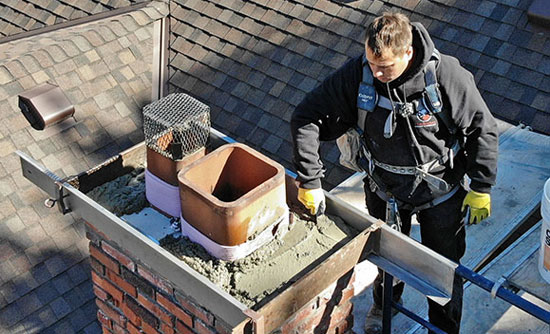
chimney repair rebuild specialists in syracuse ny repairing a chimney crown

2. The Chimney: A High-Risk Vertical Structure

The chimney is the most exposed part of your home. It catches the wind, the rain, and the snow from every direction. Unlike the walls of your home, which are protected by eaves, the chimney stands alone against the Syracuse elements.

Structural Stability and Lateral Loads

A chimney is a heavy masonry stack that relies on its own weight and a series of metal wall ties to stay upright. In older Syracuse homes built between 1920 and 1950, these metal ties have often rusted away or were never installed to modern standards.

  • The Risk: If the mortar joints at the base of the chimney or the roofline wash away, the chimney loses its lateral stability. During a high-wind event, a compromised chimney can lean or collapse.
  • The Liability: A falling chimney does not just damage the roof; it can weigh several thousand pounds. If it falls outward onto a neighbor’s property or a public sidewalk, the property owner may be held liable for failing to maintain a known structural hazard.
  • The Restoration Solution: Keeping your chimney safe through professional repair or restoration is the only way to ensure these structural connections remain secure. By reinforcing the masonry ties and repointing the base joints, we transition the structure from a potential hazard back into a stable architectural asset. This proactive maintenance serves as documented proof that you are prioritizing the safety of your household and the surrounding Syracuse community.

Internal Decay and CO Risks

When we inspect chimneys in neighborhoods like Eastwood or the Valley, we often find flue blockages. As the interior liners or clay tiles age, they crack. Shards of these tiles fall and collect at the smoke shelf. This blockage prevents the free flow of combustion gases, forcing Carbon Monoxide back into the home.

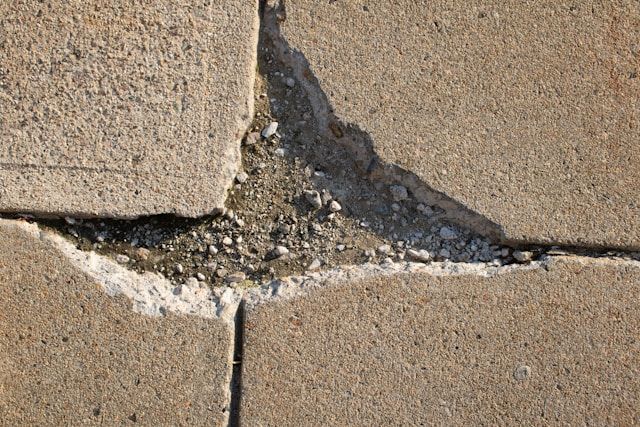
broken sidewalk repair syracuse ny

3. Walkways, Steps, and the Duty of Care

While the chimney is a vertical risk, your entry steps and sidewalks represent a daily horizontal risk. This is where most premises liability claims originate.

The Slip and Trip Science

In Syracuse, Frost Heave is a major factor. As the ground freezes, the soil expands, pushing concrete slabs and stone steps upward. This is rarely a uniform process.

  • Differential Settling: When the ground thaws, the masonry does not always settle back into its original position. This creates edges and uneven transitions in sidewalks, steps, and other stucco and concrete walks around a property.
  • Legal Standards: Most building codes and local Syracuse ordinances define a trip hazard as any vertical change in level of 1/4 to 1/2 inch or more.
  • The Masonry Fix: A-Z Construction does not just patch these issues. We address the sub-base drainage to prevent water from pooling under the steps in the first place, stopping the cycle of heaving.

4. How-To: The 5-Minute Masonry Safety Audit

We recommend that homeowners perform this chimney inspection every spring after the snow melts to identify risks before they become injuries.

  1. The Visual Plumb Test: Stand at a distance and look at your chimney against the straight line of your house siding. Any visible gap between the house and the chimney stack is a sign of foundation settling or tie-failure.
  2. The Red Dust Scan: Check your gutters and the base of your chimney. If you see piles of red sand or thin wafers of brick, your masonry is actively spalling.
  3. The Screwdriver Test: Take a flat-head screwdriver and gently poke the mortar joints in your front steps. If the mortar feels like stone, it is healthy. If it crumbles into a sandy powder, the bond has failed.
  4. The Hollow Tap: Walk firmly on your masonry porch or steps. A hollow thud indicates that a void has formed underneath the masonry, often due to water washing away the sub-base.
  5. The Chimney Crown Check: Using binoculars, look at the very top of the chimney. The concrete cap should be smooth. If you see cracks or vegetation growing out of the top, water is being funneled directly into the center of your walls.

5. Local FAQ: Masonry Maintenance in Onondaga County

Q: Why can’t I just use store-bought cement to fix my steps?
A: Store-bought cement is often much harder than the original 50-year-old bricks on your Syracuse home. If the mortar is harder than the brick, the brick will crack during the next freeze. Professional tuckpointing involves matching the compressive strength of the mortar to the existing masonry.

Q: Is a leaning chimney always a total replacement?
A: Not necessarily. If caught early, we can often re-tie the chimney to the structure and stabilize the foundation. However, if the lean has caused the flue liner to shift, it may be a fire hazard that requires a more significant rebuild.

Q: Does the City of Syracuse fine homeowners for cracked sidewalks?
A: Yes, the city can issue Notice to Repair citations. Beyond the fine, the greater risk is the civil liability if a pedestrian trips on a heaved slab on your property.

Q: How often should a Syracuse chimney be professionally inspected?
A: Given our weather patterns, a structural inspection every 2 to 3 years is recommended. If you use your fireplace frequently, an annual safety check is a must.

The A-Z Construction Commitment

Masonry is a living part of your home: it breathes, moves, and reacts to the environment. By addressing spalling bricks and uneven walkways today, you are doing more than just improving your home’s appearance. You are fulfilling your duty of care as a property owner and ensuring that your home remains a safe haven rather than a liability.

Contact A-Z Construction today for a professional masonry safety audit.

Or call 315-488-5292 â€” Monday through Saturday, 7:00 AM to 7:00 PM.

Related: Chimney repair and rebuild services in Syracuse, NY


A-Z Construction & Restoration  |  Syracuse, NY  |  Serving Onondaga County Since 1984  |  Licensed & Insured  |  EPA Lead-Safe Certified

â–˛